Showing posts with label transportation. Show all posts

Saturday, October 01, 2011

Spreading one's person over the territory of the little man; or, notes on loving thy fellow passenger

New research interests (the origins of which I've been meaning to write about) have led me to examining Anglican thinking about society and international relations in the 1930s.

Said research has led me to the Guardian, which refers not to the better known contemporary paper of that name but rather an Anglican (more specifically, Anglo-Catholic) newspaper. In looking through the volume for 1935, I ran across the following comment which has nothing to do with my project but  -- since I have spent some fair amount of time on British trains in my life -- I found interesting.

Comfort for the Third-Class

The third-class railway traveller is being better cared for than he was twenty-five years ago, and at Euston Station last week visitors were able to compare a typical train of 1910 with one of the best of 1935. The improvement in the third-class accommodation proved the eagerness of the railway companies to consider the needs of the poorer traveller.

The best of all reforms is the provision of arm-rests; no longer will the bulky traveller be able to spread his person over the territory of the little man, for each will get the space that he has paid for. It is a pity, however, that while the long-journey traveller is being thus considered the unfortunate passenger on the suburban services is but little better off than he was forty years ago. On some lines, indeed, he is worse off, for whereas once upon a time the rule was ‘five a side,’ to-day, by a slight widening of the coaches, six are packed in.

‘Six a side’ in trains to-day has been the cause of more bickering and ill-feeling on the way to work or on the homeward struggle than any amount of political argument. Moreover there are often about eight other passengers standing in a compartment, to the discomfort and irritation of all. It is difficult for a man to love his neighbours on a journey from, say, Liverpool Street to Ilford.

'An Onlooker's Diary', Guardian, 10 May 1935, p. 304. (Paragraph breaks added)

A question to those who might know this kind of thing: when did 'third class' rail travel disappear?

I mean as an explicit category, of course, and not as a subjective experience.

(The 'historical bycatch' series; explanation.) 

Friday, July 01, 2011

On Chesil Road

For work reasons, I spend a fair amount of time in London, and whenever I'm there I spend a fair amount of time along Euston Road (largely because the British Library and St. Pancras Station are located on it).

The Wife and I have come simply to refer to it as The Worst Road in the World, as it is perpetually jammed and loud and crossing it can take what seems like an eternity if you wait for the lights (like good Germans do) or like some kind of crazy death-defying stunt if you don't.

Hence, I rather like this plan:

From 22 September the installation White Sound, created by the American sound artist Bill Fontana, will fill the street with the sound of the sea and the unique beach, an 18-mile long pebble bank which is part of the Jurassic Coast world heritage site.

Now, if were possible to navigate Euston Road with one's eyes shut, this would be perfect...

Thursday, June 30, 2011

A bridge: too far?

My first reaction to these images (via Spiegel Online) of the new, enormously long sea-spanning bridge in China was amazement.


My second was to wonder what J. G. Ballard might have made of it. And part of me is now sad to think that a water-borne sequel to Concrete Island will never be written. 

Wednesday, October 20, 2010

We will fight on the beaches, we shall fight on the landing grounds....

...but, no longer, it seems, on the train platforms.

By the end of 2013, Germany's rail company Deutsche Bahn wants to include the Cologne-London route in its regular offerings. From that point onwards, high-speed ICE trains will rocket through the French countryside at 300 kilometers an hour before travelling -- slightly slower -- under the English Channel to London.

Preparations for that date, however, are well underway -- and on Tuesday, the first ICE pulled into St. Pancras Station in London following a test run. The train was received by the head of Deutsche Bahn Rüdiger Grube and German Transport Minister Peter Ramsauer.

Of course, Jerry has this time cleverly disguised himself with British markings.


We've seen this trick before...


(And, of course, here.)

For you, Tommy, ze journey is just beginning!


(Photo via)

Tuesday, January 05, 2010

What's all this then?

Ah, yes: I think we can rest easy that all is well with the implementation of anti-terrorism legislation in Britain:

They [a series of stupid, plodding efforts by the police to bother law-abiding citizens] stem from section 44 of the 2000 Terrorism Act, which designates particular areas as vulnerable, and within those places the police can stop and search whomever they want, even without what is legally termed "suspicion". As the Metropolitan Police's website helpfully explains: "Officers have the power to stop and search a person who they reasonably suspect to be a terrorist."

Thus, last year, police officers must presumably have thought they had reason to suspect that Alex Turner, taking pictures of a fish and chip shop in Chatham called Mick's Plaice, was in fact a terrorist. Chatham no longer has its dockyard, or indeed any army barracks... but that didn't stop two officers from stopping him taking his fishy snaps; and when Mr Turner – quite rightly, in my view – questioned their authority to stop him, he was arrested, held handcuffed in a police van, searched and interviewed by two plain-clothes officers.

(Observant readers will note that the act that has led to such things was passed before that fateful Date That Supposedly Changed Everything.)

And these are the people that will soon have new powers to root around in our pants.

I'm...hmm...yes, I think reassured is the word.

On the other had, think of the positive side of this: you'll be able to tell future generations of a time when airline travel was not a grim, dehumanising torture. (Even though, by some counts, things have rarely been better, safety-wise.)

I already feel nostalgic for...what, a couple of weeks ago?

Saturday, May 23, 2009

A kiss is just a kiss

A missive from the past, with some personal relevance this weekend:

FAREWELL KISSES

Chief of Paris Police On Public Embraces

NOT IMMORAL


Paris breathes freely again, the Prefect of Police, M. Chiappe, having declared officially that 'kissing in public is not an immoral proceeding.'

Some time ago (says the B.U.P. [i.e., British United Press]) a Paris municipal councillor, M. Leon Riotor, called the attention of the Prefect to the amount of promiscuous public osculation occurring in cafés, railway stations, and other public places 'and asked that he police should suppress it on the ground that it was immoral, or likely to lead to immorality'.

M. Chiappe's reply, publicised in full in the official gazette, is a severe rebuff.

'It is quite true that people kiss each other at railway stations when saying good-bye or when greeting each other on arrival, but I see nothing immoral in that, and the police will not take any action to stop the practice.

'There is no evidence that such a custom leads to immorality'.

The Daily Herald, 18 June 1928, p. 5.

I am relieved.

Sunday, March 18, 2007

Home Again

Our travels seem to be at an end for a while, so things should be picking up here again soon. Unlike some people, perhaps, I find it takes me a while to get back into the blogging rhythm. But it’ll come back. (Take that as a threat or a promise, as you choose.)

I’ve been catching up on some things I missed while being away from the internet for a while. I’m happy to find there are a lot of interesting and well-written things that have appeared, which I still need to work through before I can recommend and discuss them.

There is, of course, also the usual torrent of stupidity out there, and I’m wading through some of that as well.

But, trenchant social commentary aside, being on the road for a while—to the US and to Greece—did bring a couple of things to mind that I thought were worth mentioning.

The first was the reminder of how unrelentingly grim domestic air-travel in America has become. (Getting to an international flight is no easier, but at least in those cases—at least with Lufthansa—there’s some free booze awaiting you once airborne.) It begins with our friends in the Transport Security Administration. Now, I am well aware that the threat of terrorism is hardly a figment in the mind of George Bush, and I don’t even object so much to all the various little indignities which go along with the more intensive searching of bags and bodies (even if there is part of me that wonders how effective all that really is).

No, what I cannot figure out is how the American version of all this (since there is tight security within Europe as well) turns out to be such a cacophonous, zoo-like nightmare. Whether at O’Hare (which has long been a less than enjoyable place for various reasons) or even at BWI, hitherto one of my favourite airports (because it is relatively small and easy to navigate), there seemed to be a level of chaos and stress involved in simply getting to the gate that I’ve never experienced before.

Take dozens of uniformed people who, when they’re not chatting and joking amongst themselves are barking some not-very-well-enunciated commands; throw in a dozen or so different signs—in a dozen different typefaces and some of them handwritten, while others, I swear, included clip art taken from Microsoft Word and were printed on some crazily out-of-date colour printer—posted willy nilly in the ‘security zone’; finally, add a hefty amount of jostling from all directions by people who only realise at the last minute – despite all those shouted commands and confusing signs - that they have to remove their coats, shoes, laptops and little plastic baggie containing all their on-board liquids. This is a recipe for misery. (Not to mention the risk of serious burns among all those people I witnessed scarfing down the coffee they bought immediately before trying to go through security. Here lurks a future lawsuit….)

Since we were delayed by weather at O'Hare, we had several hours of listening to a voice intoning at regular intervals that our security alert level was ‘orange’; this was, simultaneously, unsettling, ridiculous and useless, a rare combination. We also had CNN running constantly on monitors strategically placed throughout the terminal so that you could hardly avoid them, and CNN on that day seemed to consist solely of a concerned (but strangely exhilarated) weatherman standing in front of a very nifty computer-generated map full of blobby looking green and orange shapes that, to be honest, told me nothing.

Or, at least, his frantic efforts and expensive technical wizardry aimed at expressing the horrendous severity of it all told us no more than the four words uttered by a helpful airlines employee earlier that morning: "We got weather comin'." Indeed. We did.

As I related this tale to someone at the crime conference we attended, he suggested that perhaps this would be a great opportunity for Americans to discover the joys of high-speed rail. It seems like a great idea to me. But I’m not holding my breath. (Perhaps America could buy some trains from France.)

In happier news, the conference in Crete was excellent. There were many thought-provoking and very informative papers, some good discussion and my own contribution seems to have been well received, which was nice. More importantly, though, the food and wine provided by the organisers was top-notch. Greek food, I discovered, is not only delicious but also comes in portions which I could barely comprehend. At the dinners we attended, new dishes just seemed to keep coming from all directions, and they were all great. From a culinary perspective, I can wholeheartedly recommend the place.

From the point of view of traffic, however…let’s just say there’s room for improvement.

It’s not so much that there is an enormous amount of traffic on Crete. No, it’s not that. It’s more an issue of quality rather than quantity.

As a historian at the conference with an insider’s perspective put it to me, Greeks see things like red lights and stop signs as ‘suggestions’ rather than imperatives. (The same is true, I noticed on the highways while travelling to and from Heraklion airport to the conference venue in Rethymnon, of ‘no-passing’ zones.) Likewise, parking is something that one does wherever an inviting space seems to present itself, regardless of what signs, double yellow lines or the safety of others might, um, suggest. The conference featured several papers about the figure of the ‘bandit’ in Greek history. In countless small ways, perhaps, his spirit lives on.

Finally, I had the delightful opportunity to meet for the first time several people whose academic work I have long appreciated. As ever, I was struck by the fact that authors never end up looking the way I expect them to. It’s not a question of better or worse: they're simply…different. I notice the same things with voices, and I have always been mystified as to why there is not some kind of greater match between people’s appearance and their voices (whether literal or literary). Maybe this doesn’t strike anyone else as strange. Maybe I'm just not good at putting face to voice.

Of course, then I get to thinking about whether others have thought something similar about me.

Hmmm.

Well, onward we go…

Sunday, July 23, 2006

Running on Empty (Words)

A recent spate of articles has been making a surprising – and counterintuitive – suggestion: not only may current ‘hybrid’ cars (such as the Toyota Prius) not be all they’re cracked up to be, efficiency-wise, they are less efficient than most typical SUVs, even the hideous-for-many-reasons Humvee.
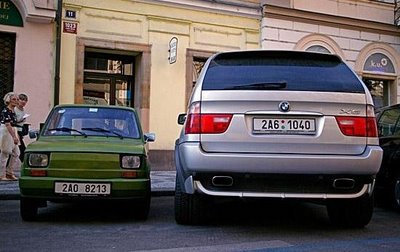
This remarkable conclusion derives from a study by Art Spinella, President of CNW Marketing Research. Spinella and his team applied a very important green principle to examining the environmental impact of different vehicles: their ‘dust-to-dust’ energy costs. This means not only taking their fuel efficiency into consideration but also the energy expended upon things such as R&D, the making of component parts, transportation, repair and maintenance and disposal. Hybrids, since they employ highly advanced composite materials and motor technology, score quite high on the R&D and production energy-usage scale. So, taking everything into account, it would seem that there is no reason for people in general (and Americans in particular) to change their vehicle purchasing habits. As Shikha Dalmia put it in a gloating article at Reason: ‘Now here's a catchy slogan for the next Save the Earth campaign: Have you hugged a Hummer today?’

Terribly droll. But while I enjoy seeing a specious bit of conventional wisdom punctured as much as anyone, there was something about this story which didn’t seem right. Sure enough, a thirty-second search brought up an article from HybridCars.com which provided a few key missing points. As in any vastly detailed, mathematical analysis of efficiency, the original study made some key assumptions crucial to its final conclusions. One of them was that a typical hybrid car would run for 100,000 miles while a typical Hummer would run for three times that amount. This assumption, of course, drastically shrank the overall energy cost per mile driven for the SUV while raising it for the hybrid. (The Reason article did mention this assumption, but gave it far more credibility than it seems to deserve.)

There was another key point given insufficient airing in the articles which reported it. This was the obvious point that, although as cutting edge technological products hybrids have a far higher R&D energy component, the more years they are produced, the more these costs will be amortized, just as they have long been with the old-school, off-the-shelf components of the Hummer.

As the author of the original study himself points out – something ignored, for instance, in the Reason article – the Hummer’s energy advantage will be short lived. As hybrid technology develops, its per-unit energy costs will sharply decline, which, in combination with their superior fuel efficiency, will make them far and away superior to gas-guzzling SUVs, even when analysed in terms of their dust-to-dust energy costs.

As reported at HybridCars.com, Pinella believes

‘It would be totally different in three years. The hybrids will look
significantly better. The new hybrids they are developing now—the new ones that
I've seen, Prius III and Prius IV—are so much more simplified. They'll do what
the current versions do, but with far less complexity, lighter motors, more
recyclable parts, and longer lasting components. The current Prius, for all
intents and purposes, will be the Model T.’

It is troubling enough to see the wilfulness with which a detailed, carefully argued and cautiously laid out scientific study – which in no way ended up hostile to the further development of hybrid technologies – has been spun into something marking the death knell for environmentally-friendlier autos. Some of this is simply incompetent - or dishonest - reporting, much of it aimed at an audience with generally poor skills in scientific and mathematical reasoning.

But beyond all the specious number crunching, it was the self-satisfied tone of many critics of alternative technology and environmentalism which so stood out. From between the lines comes the joyful shout of ‘gotcha!’ as the environmentalists – those naïve elitist dilettantes – get their deserved comeuppance. (See the sarcasm dripping from Dalmia’s quote above.) For some, this whole discussion seems to revolve not around the questions of efficient resource usage or pollution, but rather about tarring environmentalists as yuppie liberals with a smug sense of superiority who deserve to be taken down a peg or two.

The battle over the environment is no longer (if it ever was) one mainly about facts, but instead part of a broader culture war, with environmentalists increasingly being stereotyped (once again, after a period of relative popularity) as naïve, foolish and liberal elitists. Thus, for some time, the anti-environmentalist verbal barrages have been most often fired from the right (where, either for reasons of greed or God, the environment is dismissed) or from the libertarian free-marketeers, who seem to see environmentalism only as a new excuse for big-government to mess with people's freedom.

The political imbalance is, however, not as stark as it seems, either in the past or the present. While vast amounts of environmental damage ensue from profit-driven capitalist enterprises and the consumerist lifestyle which it supports (or which supports it, depending on your view), the environmental record of ‘real-existing’ socialism was grim, whether in its Stalinist or Maoist flavours. (I heard a radio report only yesterday on the improvement in the water quality in the Elbe immediately following the collapse of the GDR. The hitherto largest nuclear disaster in world history will always remain a stain on the environmental record of the left. And China? I don’t even know where to begin…)

Closer to home, the West has always seen no shortage of blue-collar contempt for those who would stand in the way of mining, logging or industrial activities for the sake of water quality or biodiversity. In Europe, where green parties have established their own niche in the local political ecologies, the distinctions are somewhat clearer, as unlike in the US, unions and environmentalists don’t have to necessarily tolerate each other’s presence on the same team. As a result, the strains between red and green tend to come more out into the open. They resulted in some of the most dynamic tensions of Germany’s previous red-green coalition government (which, in many ways, were more fundamental, than many of those being staged in the current conservative and social-democratic one.)

Whereas left and right economic policy tends to be simply about producing more, green thinking at least raises questions about what we produce and how it is produced. And this, of course, points to a difficult – and perhaps insoluble – conflict of interests and raises disturbing questions about our lives as producers and consumers. It suggests that we may have to live differently, and, at least in a material sense, with less.

This is an unpopular message, and probably one of the reasons why the green movement will remain a niche interest. In a system where, even today, we are told that more is better, regardless of what it is or how it is produced, greens are the only ones who – however partially or imperfectly – seem to raise the truly fundamental (and therefore truly radical) questions.

The answers, of course, are a more difficult matter. And it is likely that the most promising ones will not only emerge from a single political tradition. European green parties have traditionally been critics of consumerism and profit-driven exploitation. They have also, however, often put themselves against big-government statism and the centralising tendencies of the left. If this position independent of left and right has allowed the greens to be highly creative, it has also been the source of their most destructive internal centrifugal forces and, furthermore, guarantees a continuous debate about their political identity.

Indeed, green parties tend to have their own shortcomings, such as a generally paranoid attitude toward science and sometimes romantic notions about peace and war. Moreover, although the mainstream versions of most political traditions have shown a criminal disregard for the environment, there have been streams within all of them which have taken a different view. In an important sense, environmentalism doesn't simply 'belong' to the greens.

There is, furthermore, no reason to see environmentalist perspectives as contrary to issues beloved of the right, whether national security or economic vitality. The goal of reducing dependence on oil should warm the hearts of any security-obsessed right winger, just as the economic potential of becoming a leader in green technologies (something which Germany has been doing with some success) should be good for business. (An article from yesterday’s Süddeutsche Zeitung suggests that the US market is already beginning to shift slightly away from SUVs and toward more fuel efficient cars, most of them non-hybrids.)

Which brings us back to the hybrids. Hybrid cars are not going to save the planet (and, indeed, the whole debate around efficiency is a distraction from question of whether we need fewer rather than better cars). However, the argument about them raises a broader issue. The development of new technologies, which in the long term will be essential to improving efficiency in resource use and reducing ecological impacts, will often, at first, involve things which seem inefficient, such as higher R&D costs or a period of subsidisation until they have become developed enough to compete in a market already dominated by longer-established technologies. These costs will be unavoidable in many cases, and accepting them will require a certain amount of political will: on the part of consumers, voters and governments.

But as long as environmentalism is perceived either as a partisan political opinion or as a merely faddish (but nevertheless self-righteous) lifestyle choice, there will be a great tendency for it to become the target of critics who will simply see it as some kind of alien imposition on their version of the good life. In some cases, this perception is real: there are political perspectives which are truly incompatible with green thinking. But in many cases, this is not so. Developing a sensible, sustainable approach to the environment will most likely not be based upon ideas from any single political tradition. Instead the thinking and approaches which will have to emerge will have to be a cross-breed of different principles and compromises among them, an amalgam of perspectives on humanity and social organisation and a mixture of technologies and new models of how to live.

It will be composed of many different elements. It will, in short, be a hybrid.