Showing posts with label men. Show all posts

Saturday, November 23, 2013

The youth of Britain, somewhat before their finest hour.

At my blog for my book on the Pace murder trial, I offer a couple of excerpts from a fascinating LRB review of inter-war British masculinity.

With his ‘constant combing of well-oiled locks of long hair, tidy clothes and well-kept hands and nails’, as one exasperated army physical training instructor put it, the new teenager was symptomatic of a greater national effeminisation that was undermining Britain’s ability to defend itself in an ever more dangerous world. 


Ah, the eternal problem of 'today's youth'.


Friday, July 09, 2010

Manliness-ness, the sequel

This is interesting:

What if your million copy-plus bestselling inspirational book calling on men to act more manly, aggressive, even violent became a key source of inspiration for a ruthless cultic Christian paramilitary fundamentalist crime syndicate that controls most of the Crystal Meth traffic in the US and is fond of tossing severed heads into Mexican discos ?
The awkward confrontation between a religious conservative's celebration of a more aggressive manliness and the actual horror of real aggressive manliness reminded me of something I wrote back in the early days of this humble blog, in which I concluded:

Those who do long for a return of the 'real man' should be careful what they wish for.
The rest.

As an addendum, those interested in the reality of more traditional male violence cultures in the US should check out Randolph Roth's recent book American Homicide (UK/US). I'm going to be commenting on the book at a panel at a conference in Chicago in November. It's thoroughly compelling.

(via Blood and Treasure)

Tuesday, January 19, 2010

Frauenpower

While taking a short mental break from research in the British Library, I ran across a couple of interesting articles at the New York Times.

One is on changes in family life and motherhood in Germany as more women enter the labour market.

This is hardly a new topic, of course, but there are elements in the article that touch upon what I've found to be a distinctive mixture of modernity and traditionalism in my adopted homeland.

Much of it focuses on Bavaria, where these tendencies are, in my experience, more marked than usual.

As is kind of summed up in this passage:

Even five years ago, all-day schooling in Neuötting seemed unthinkable, Mayor Peter Haugeneder said. There is a crucifix in his office, in every classroom of the Max Fellermeier school and even in the Spanish-themed restaurant run by the gay butcher.

Also related in some way is an article on the increasing tendency for men to marry women who earn more and are better educated than they are.

There are, apparently, men who have a problem with this, causing some frustration in the world of dating.

Ms. Zielinski, the fashion stylist, said her best friend, a man, told her once: “ ‘You are confident, have good credit, own your own business, travel around the world and are self-sufficient. What man is going to want you?’ He laughed, but I found that pretty depressing.”

If true, it is.

Monday, February 09, 2009

Eastern front

Luke Harding's chilling article on Russian neo-Nazis is fascinating for many reasons, not least the image of Russian fascists dressing like British fascists and worshipping a German fascist, while at the same time believing that anything not Russian is to be kicked, stabbed and mutilated:

I later discover that most Russian skinheads revere the Führer, believing that his only mistake was to attack Russia. The average age here is about 15 or 16; the style is baseball caps, Burberry scarves and Lonsdale - the uniform of the British far-right. One skinhead even has a Union Flag jacket. There are several girls. The skinheads adhere to two ultra-nationalist groups - the Movement Against Illegal Immigration and the Slavic Union.
If these people weren't so vicious--a fact made abundantly clear in the article--they'd be laughable.

Friday, January 30, 2009

One of the 'helping kind'

Perhaps as a sort of sequel to my last post, here's another dispatch from the battle of the sexes, 1920s style.

HUSBANDS HINDER INSTEAD OF HELP

Wives object to Their Fooling Round With the “Washing Up”

USELESS IN THE KITCHEN

Is the good-natured husband who insists on wiping the dishes a real help or merely a nuisance?

Whichever he may be, he is certainly a very difficult person to handle.

“Helping husbands” are a product of these days of servant shortage, and Suburbia is full of them, poor dears, but whether they do any good, or whether their services are appreciated is open to question.

“Personally, I would sooner have my husband out of the kitchen,” a woman who possesses one of the helping kind, said to the Daily Sketch.

“But he means so well, that I haven’t the heart to tell him so.”

“Directly the evening meal is over he says: ‘Now, come on, let’s do the dishes; you wash and I’ll wipe,’ and he bundles off into the scullery and messes about and gets in the way and breaks things.”

EVERYTHING TAKES HIM TOO LONG

“And he takes so long over everything! I know that I could do the job quicker by myself. About four minutes to every cup—and he dries and polishes it, and wipes it well round the ears as it were, before permitting himself to return it to the dresser.”

“It’s the same with other things. ‘I’ll run the sweeper over the carpet,’ he says, and amuses himself for half-an-hour doing it all wrong.

“He is a perfect dear, of course, and it seems awfully mean to speak of his efforts like this; but the fact remains that few men are really much use in the ordinary work of the home.”

“We had a discussion at our local debating society only last week on this very question and four out of five women who spoke declared they would rather their husbands didn’t help.”

“One woman was all in favour of the helping husband, but I happen to know that her husband is in a class all by himself. He is not only willing but capable, too, although even then I’d rather do the work myself.”

“Most women, I am convinced, would sooner the men put their slippers on, lit a pipe and settled down in the armchair with the evening paper than potter about the domestic domain under the impression that they are ‘helping’.”

“But the trouble is, how can we tell the poor dears that? When they have made up their minds to be considerate, unselfish, and helpful they’d be bitterly affronted.”

(The Daily Sketch, 21 June 1928, p. 26)

Saturday, January 10, 2009

'After the brooding, then the firepower.'

A few bits and bobs I've run across in my last few days' reading that seem, somehow, to fit together.

Via Norm, an intriguing excerpt from Charles Baxter's interesting-sounding novel, The Feast of Love:

They sulk, men, so many of them. They bear grudges and they get violent almost as a hobby, the ones I've known. Didn't you realize this? Ask around. As a gender they're - you're - always scheming or at least they seem to be scheming because they never ever tell you what's on their minds. The sample I've had. They just sit there day after day and they brood. After the brooding, then the firepower.

A case study that appears in an article by criminologist Fiona Brookman, 'Confrontational and Revenge Homicides Among Men in England and Wales':

Since Jeff (aged 34) married into the victim’s family a great deal of animosity had occurred between him and his brother-in-law (Ian, aged 39). Specifically, Ian had, on two separate occasions, physically assaulted his sister, Sue (Jeff’s wife) in respect of trivial matters. The day before the killing, Jeff went to work at 4.00 p.m. on a night shift. Some time after 10.00 p.m., Ian arrived at his sister’s house in a drunken state, shouting to be allowed into the house. On gaining entry he became abusive towards Sue and punched her, breaking her nose. When Jeff arrived home from work he saw his wife’s injuries and was informed of the previous night’s events, to which he responded, “I’ve had a gut’s full of him hitting you around”. Jeff went to bed and when he got up he proceeded to put into action his plan to avenge his wife’s beatings. He cancelled work for that evening and obtained a shotgun and cartridges from an acquaintance. At around 11.20 p.m. he walked the short distance to Ian’s flat, knocked on the door and, without saying a word,shot him twice in the head at close range. Jeff then telephoned the police to explain what he had done stating, “he got what he deserved, he gave my misses a kicking. I hope he dies”. (pp. 44-45)

A couple of excerpts from David T. Courtwright, Violent Land: Single Men and Social Disorder from the Frontier to the Inner City:

...
[T]here is an abundance of other evidence that Gold Rush California was a brutal and unforgiving place. Camp names were mimetic: Gouge Eye, Murderers Bar, Cut-throat Gulch, Graveyard Flat. There was a Hangtown, a Helltown, a Whiskeytown, and Gomorrah, though, interestingly, no Sodom. Even innocuously named places could explode into violence. The city of Marysville reportedly experienced seventeen murders in a single week, prompting the formation of a vigilance committee. Suicide and violent death occurred in all mining regions. Witnesses wrote of men suddenly pulling out pistols and shooting themselves, of bodies floating down the river, of miners stoned to death in gambling disputes. They described men who had become beasts, biting and pulling hair, flogging one another without mercy, cropping boys' ears, laughing at executions. (p. 75)

But whatever the cowboys' guns brought in the way of deterrence and emergency use was paid for by an increase in accidental death and injury. Cowboy and noncowboy alike died when guns tipped over, dropped from pockets, or fell from blankets. The Caldwell Post, a Kansas cattle-town newspaper, estimated that five cowboys were killed by accidental gun discharges for every one slain by a murderer. Those who survived accidents were often horribly injured, living out their lives with shattered knees or shot-away faces.

The other evil associated with gun toting was the increased incidence of unpremeditated homicide. 'I always carried a gun because it was the only way I knew how to fight,' [cowboy 'Teddy Blue'] Abbott admitted. 'That was the feeling among the cowpunchers. They didn't know how to fight with their fists. The way they looked at it, fist fighting was nigger stuff anyhow and a white man wouldn't stoop to it.' (p. 91)

From comments made by a former 'sweet boiler' describing dispute settlement in late 19th and early 20th century Manchester that I quote in my book (which I was re-reading, astonished to find out all the things I once knew):

You always settled your arguments with a fight. You see it was the only expression you had. They wouldn’t listen to you arguing, you know what I mean. He’d be looking while he’s arguing with you…he’d be looking for an opening to let you have one. You see…it was very common. In fact, in the workshops, the public houses at the time of Sullivan or Corbett, the men were always fighting. In fact, behind my grandfather’s house there was a canal and a croft. Any quarrels which my grandfather and any of his sons had with anybody would be settled by one son on the Sunday morning on this croft. [...]

Question: How do you mean…how do you mean by one son?
Answer: Because one son was kept for that purpose, fighting.
Question: He was a fighter for the family?
Answer: He was a fighter for the family. Bare fists…and very often his opponent was knocked out. They’d throw him in the canal and then bring him out when he’d recovered. ‘Course, often as not, a ducking would be enough. (p. 91)
From an excellent essay by Simon Sellers at Ballardian:

[...] Birmingham proceeds to whip up a storm of hatred against all cyclists (an extremely dirty tactic that, as we shall see, he decries when used by others). In the comments section of his blog, his followers took up the call, branding cyclists ‘poofs’, ‘clowns’ and ‘dickheads’ and coming up with more ways to kill them — like ‘rotating knives on car tyres’ (Birmingham might think such comments are harmless fun, but in Britain the journalist Matthew Parris advocated stringing piano wire across cycle paths to decapitate cyclists, then had to apologise and retract his attempt at ‘humour’ when real-life stories of cyclists being garroted subsequently came to light; I’ve also written previously about my own experiences observing how anti-cyclist hatred is rife on the roads after such articles get printed).

From the Sunday Pictorial, 12 February 1928:

REFEREE MOBBED

Home Team Protect Him from a Hostile Crowd

There was a remarkable scene after the football match at Minehead yesterday. The referee, Mr. F. Chidgey, of Watchet, had to be escorted to his hotel by members of the Minehead team to prevent a large and hostile crowd from molesting him. But for the team's action Mr. Chidgey would have been roughly handled. The match was a Somerset Senior Cup game between Minehead and Wells City, Wells winning by a penalty goal. (p. 2)

Have a nice weekend.

[UPDATE] Here. Via Boing Boing.

Wednesday, October 31, 2007

Road to nowhere

I had, actually, been planning on writing something drawing a connection between Cormac McCarthy's best-selling post-apocalyptic novel The Road (which I read a couple of weeks ago) and the recent UN Environment Programme report highlighting a bunch of very bad news about the future.

But it seems that George Monbiot beat me to it.

Cormac McCarthy's book The Road considers what would happen if the world lost its biosphere, and the only living creatures were humans, hunting for food among the dead wood and soot. Some years before the action begins, the protagonist hears the last birds passing over, "their half-muted crankings miles above where they circled the earth as senselessly as insects trooping the rim of a bowl". McCarthy makes no claim that this is likely to occur, but merely speculates about the consequences.

This is, in fact, one of the strong points of McCarthy's novel: its vagueness about the crises that led to the bleak, ash-covered world through which his protagonists travel. (However, it seems to most closely resemble a nuclear winter.)

The Road was my first McCarthy novel, and I have to say that I'm impressed. The spare, restrained language is grimly beautiful. The hushed stillness of a world that has -- except for islands and instances of horrifying brutality -- effectively come to a standstill makes even the smallest gestures of its characters somehow significant.

Having looked around a bit, it seems that there are interpretations of the book which see it as a story of religious faith and redemption. I have to say that I disagree. I admit that the ending left me a bit confused (and perhaps disappointed) at first, as it seemed to betray the novel's hitherto relentlessly hopeless logic.

However, thinking about it in retrospect, the conclusion is far more ambiguous than it at first seems. Rather than salvation, I think the novel's denouement might equally be seen as a mere prolongation of the horror.

Furthermore, its final passage, following immediately upon a character's expression of theistic hope, suggests what might be the author's more grim naturalism:

Once there were brook trout in the streams in the mountains. You could see them standing in the amber current where the white edges of their fins wimpled softly in the flow. They smelled of moss in your hand. Polished and muscular and torsional. On their backs were vermiculate patterns that were maps of the world in its becoming. Maps and mazes. Of a thing which could not be put back. Not be made right again. In the deep glens where they lived all things were older than man and they hummed of mystery.

It is perhaps too simple, as Monbiot does, to see The Road as simply an 'environmental book'. It is a haunting book about the end of the environment and the collapse of, essentially, everything.

But in a wide-ranging and intriguing essay on the novel at the New York Review of Books, 'After the Apocalypse', Michael Chabon observes,

Horror fiction proceeds, in general, by extending metaphors, by figuring human fears of mortality, corruption, and the loss of self. The haunted house (or planet), the case of demonic possession, the nightmare journey to or through a charnel house, the transubstantiation of human flesh into something awful and foul, the exposed wolfishness of men, the ineradicable ancestral curse of homicidal depravity—all of them tropes to be encountered, in one form or another, in McCarthy's work—trade on these deep-seated fears, these fundamental sources of panic, and seek to flay them, to lay them open, to drag them into the light.
He concludes:

What emerges most powerfully as one reads The Road is not a prognosticatory or satirical warning about the future, or a timeless parable of a father's devotion to his son, or yet another McCarthyesque examination of the violent underpinnings of all social intercourse and the indifference of the cosmic jaw to the bloody morsel of humanity.
Chabon is right that the book is not simply about either of these, and his own focus on the novel's expressions of specifically parental fears is correct enough. But I think that in itself might be too limiting, and a strong element of that latter trope Chabon mentions is obvious: the book is not only about where we might be headed but also about whence we have come and, thus, about who we are.

'There is no God and we are his prophets', says one of the few characters the father and son protagonists encounter on their journey: 'People were always getting ready for tomorrow. I didnt believe in that. Tomorrow wasnt getting ready for them. It didnt even know they were there.'

That's the thing about the universe that many people seem to have a hard time grasping: it doesn't care about us. Human relationships and imagination do, on the other hand, provide meaning, as the book effectively and movingly expresses. But these are fragile things.

I plan to read more McCarthy soon, probably No Country For Old Men, which, I see, is soon to be a film by Joel and Ethan Coen. The trailer looks...well, terrifying. (Considering that McCarthy focuses on the intersections between masculinity and violence, I'm surprised it's taken me so long to pay attention to him. I think this was because I had him pegged as a 'western' writer, and that's not a genre that has typically appealed to me. Time to reconsider...)

One other association occurred to me while reading The Road. It called to mind somehow the music of Tom Waits, in particular his album Blood Money. (If ever there were a soundtrack to the end of the world, Tom Waits would have to be on it.)

The opening track, 'Misery is the River of the World' contains lyrics which could have served as an epigraph for McCarthy's novel:

All the good in the world
You can put inside a thimble
And still have room for you and me

If there's one thing you can say
About Mankind
There's nothing kind about man
You can drive away nature with a pitch fork
But it always comes roaring back again.

And it also contains the beautiful song, 'All the World is Green', which, in the context of The Road, comes across as a fitting lament for a lost world:

The moon is yellow silver
Oh the things that summer brings
It's a love you'd kill for
And all the world is green
He is balancing a diamond
On a blade of grass
The dew will settle on our grave
When all the world is green.


(Tom Waits, 'All the World is Green', live on the David Letterman Show, 8 May 2002.)

Wednesday, September 06, 2006

Slaughtering cows to get butter: Continuing evidence that the right wing has lost its marbles

1. At Real Clear Politics, David Warren, who is also a columnist for The Ottawa Citizen, manfully wields his keyboard to attack the two recently released Fox News journalists Steve Centanni and Olaf Wiig not only for cowardice but also for ‘doing the enemy’s work’. Warren apparently believes their willingness to make a videotaped ‘conversion’ to Islam while being held captive by Fatah symbolises all that is wrong with the weak-kneed, ‘chestless’ West.

While one should definitely take a sufficient pause to emphasise the disgusting gall it takes to heap scorn on these two captives from his safer base-camp in Ontario (ah, the bravery of being out of range), it’s worth noting that Warren is not alone in needing to project a (compensatory?) hypermasculine image through his prose. His macho typing seems to exemplify a certain trend amongst the Right’s growing ranks of armchair warriors. Glenn Greenwald, at Unclaimed Territory, explores this trend and nicely dismantles Warren’s arguments. As Greenwald argues:.
David Warren really is a poster child for so much of the forces driving our country to endless wars and reckless destruction. It's the same mindset that allows people who have never sacrificed or risked anything for their country to accuse those who have risked their lives of being cowards and appeasers (see Jack Murtha, John Kerry, Wesley Clark, and on and on and on).
Quite so.

Perhaps these guys would be better off simply buying a Hummer if they have, uh, masculinity issues to work out.

2. Right-wingnut Rush Limbaugh identifies rising rates of obesity as caused by…liberalism. There are a lot of bizarre things in Limbaugh’s statements, as ever. It's so difficult to keep up with them - and he's just turned into such a self-parodying joke that it's not really worth spending the time on it - but every once in a while something really special emerges from the nasty little swamp of his thinking. For example (via Crooks and Liars), he said the following, after some comments about UNICEF being a ‘scam’ to get people to love the UN:
UNICEF got it all started. We’ve seen the babies with the extended tummies, the walking skeletons, told that kids can’t learn unless they’re fed. We’ve been guilted into pouring resources on the problem. And now, now, the latest crisis is that there is obesity among those who are impoverished. Because we are sympathetic, we are compassionate people, we have responded by letting our government literally feed these people to the point of obesity. At least here in America, didn’t teach them how to fish, we gave them the fish. Didn’t teach them how to butcher a — slaughter a cow to get the butter, we gave them the butter. The real bloat here, as we know, is in — is in government.
OK. I admit I was born and raised in a suburb and don’t know all that much about farming. I do think, though, that Mr. Limbaugh is somewhat confused about how butter is made. Furthermore, since the report he’s talking about here deals with American obesity, I’m not sure what the connection is with UNICEF, which provides food assistance to poor and developing countries. (You know, places where an overabundance of Big Macs would be a health crisis they’d be happy to face.)

However, there is another problem with Rush’s outburst, one which emerges quite regularly in right-wing arguments about the multifarious evils of the welfare state. It is simple: if government spending on poverty were the cause of obesity and ill-health, then one would expect to find at least a recurring correlation between the size of a country’s welfare state and its obesity rates. According to this logic, European societies (or, say, Canada) should be currently facing much higher rates of these problems than the US. Which is…decidedly not the case, as these figures (via the International Obesity Task Force) suggest.

I find it helpful to repeat this exercise whenever an argument comes up that the welfare state has caused all sorts of Very Bad Things in the good old USA, such as violent crime, family break-up, teen pregnancy etc. It’s not that all liberal policies over the last half century have always made sense, but let’s distribute blame and credit where they’re due. What might help here is a kind of political Elk Test to be applied to Evil Welfare State arguments before they are allowed out on the road.

The test is simple. Ask yourself: ‘Has Problem X been significantly worse in Sweden than in America?’. If not, back to the drawing board.

3. At TomPaine.com, David Corn has an interesting discussion of what might be the growing ranks of the Bush-is-an-idiot camp…among conservatives.

Like Corn, I’ve long thought that simply labelling George W. Bush stupid was perhaps not politically wise. I’ve also wrestled with the problem of whether his demonstrated inarticulacy and ignorance is real or some kind of folksy act to make him seem like a regular guy. But, as Corn points out, this is a serious problem, and not just for those who oppose him.
If the commander in chief cannot talk more articulately about his strategy for winning an elective war he initiated, the problem is serious. It’s become a truism tossed about by partisan Democrats looking to score political points, but it actually is true: Bush has little to offer but stay-the-course-ism. And he shows no signs of considering other options. His plan once was rather simply stated: The United States would train Iraqi security forces and when the Iraqis can take over the United States would leave. But as sectarian violence spreads—and the security forces become part of the conflict—that basic plan becomes thinner by the day.
With a lot of things going badly wrong and a potentially disastrous mid-term election on the way, I can imagine that there are a lot of disappointed and angry conservatives out there.
In the meantime, the plan-free war continues, and the Bush-backers mainly duck that uncomfortable issue: whether this war is too much for the man who launched it. That does appear to be the big elephant in the room. And it seems that even conservatives and Republicans are finding it difficult to ignore its smell.
4. And, in Germany, far-right extremists made an embarrassing faux pas during one of their recent publicity campaigns:
Ironically, the photo in question is of an attractive blond in a tank top and short skirt next to the slogan: "German is Hot!" But in an embarrassing faux pas for the German nationalists, a Berlin Web blog found out that the Teutonic hottie is actually a Czech lingerie model. So much for offering a "free-patriotic point of view," as was supposedly the remit of the less-than-objective Objektiv.
The photo was also used without permission, and copyright infringement proceedings might be on the way….

Saturday, September 02, 2006

Men. Real Men. Real, real men.

A guest weekend dispatch from The Wife (needless to say, I beg – but in a manly way – to differ): (PS: The fine figure of humanity in the picture below is not The Wife.)

Of course we know that men in the West are oppressed (poor things). They are underrepresented in politics and administration, they have a hard time making it into high-quality, responsible jobs (and if they do make it they are usually underpaid while forever fending with the patronising benevolence and straightforward dismissiveness of the matriarchs) and, because of their proverbial lack of driving talent, they are forced to pay higher car insurance premiums.

Well at least German men now have a TV-programme of their own to help take their minds off the sorrow and the pity. It is called DMAX, it advertises itself as putting variety first and uses the ingenious slogan “Neue Männer an die Macht” (power to new men) to garner eager and regular viewers. As we haven’t poisoned our lives with cable or satellite, I am sadly unable to while away my free time with this exciting new feature, but the website is itself revealing to the point of being offputting.

There is the picture of a man jumping across a canyon, by the looks of it. (It might be a photoshop job, but who knows these days.) The schedule features programmes on monster houses, mega cars and big bucks. [Nothing small in these pants. -- Ed.] There is a fast-cut trailer displaying masculinity in different shades and colours (no, actually, come to think of it, not different colours): Ewan McGregor à la Obi Wan with a vicious (by Ewan standards) snarl, Louis Theroux being indecently assaulted by a massage master, a professional playboy on a yacht, an obese team of scrapyard owners (who’ve already had plenty of media exposure in Germany) and, by way of an antidote, Morgan Spurlock trying to get rid of some of the excess weight put on during his notorious fast food experiment. (Click on 'Trailer ansehen' to have the pleasure.)

It not only shows boys but also their toys: plenty of more or less shiny metal with two or four wheels, sledgehammers and wheelbarrows and, somewhat mystifyingly, an exploding portable toilet. And then there are brief references to archetypal settings of the male quest for identity, a dusty desert, a splish-splashing ocean and somewhat more mundane but no less treacherous building sites.

Now I wonder what makes these men new: they’re silly, they love fast machines and they play pranks on each other.

What hath Fight Club wrought?

For the best example of truly new manhood in that bunch, I’d pick Louis Theroux though:

Wednesday, July 19, 2006

Manliness-ness

Over at Reason, there is an intriguing review of Harvard professor Harvey C. Mansfield's book, Manliness. The book's argument, such as it is, is summarised by reviewer Cathy Young as follows:

Men - the manly kind, at least - are by nature strong, dominant, aggressive, self-confident risk takers. Women are the weaker sex, dammit, and they ought to face this fact, stop trying to be men, and temper the excesses of manliness with nurturance and gentle criticism.

Mansfield, Young points out, has been riding this hobby horse for several years now, bemoaning the loss of an older and presumably more genuine male lifestyle and its replacement by some kind of post-feminist wimpism.

Two thoughts, however, come spontaneously to mind on reading several of Mansfield's comments. The first: how did this guy get a job at Harvard? The second: it seems an awfully strange thing to say that what the world needs now is more aggressive masculinity.

It would be easy enough to laugh off Mansfield's nostalgia for a world of 'real men' were it not for the fact that, as Young points out, he seems to be part of a broader movement. Indeed, 'a conservative cult of manliness has been on the rise for some time now.'
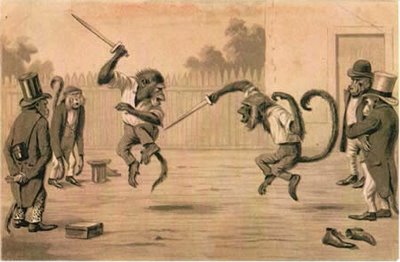


The cult of manliness is visible enough, but it's not only been on the right. It was not all that long ago that Susan Falludi was touring round with Fight Club author Chuck Palahniuk bemoaning the plight of modern men bereft of a solid masculine identity. Fight Club (first published ten years ago, believe it or not) was itself a vivid - if ultimately unsatisfying - exploration of modern manhood. The right-wing version of all this agonising about modern men is far more predictable; it is also, in many ways, less sophisticated than even Fight Club's rather one-dimensional advocacy on behalf of the male of the species.

It may often be the case, as Mansfield writes, that 'the manly man struts and boasts'. It is also true that such behaviour has been a central element in the mainstream sex-roles of most customary cultures. But not only did the traditional manly man strut and boast, he also fought regularly with and (somewhat less regularly) killed his equally boastful brethren.

Which raises the question: do conservatives longing for a return of 'traditional manhood' really know what they're in for? If so, they should be a little bit more honest with the American people. (Such honesty has not been a conservative strong point in recent times - another 'traditional value' bites the dust - but there we are.)

In my book on nineteenth-century English violence, I focused on the tradition of ritualised street fighting among working-class men. There was also, of course, a more well-known tradition of aristocratic duelling. The English were by no means alone in ritualising the inevitable conflicts among their rather touchy, honour-obsessed strutting males, as historians such as Thomas Gallant, Roger Lane and Pieter Spierenburg, among others, have pointed out. Historical research on this topic is now extensive.
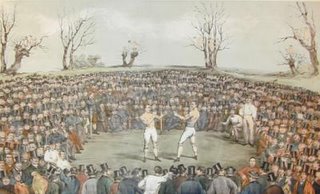
There were many, many differences in detail between the fighting cultures, say, of the Greek Mediterranean, early-modern Amsterdam or nineteenth-century Chicago, but they were also remarkably similar in that male 'honour' - in one specific form or another - was highly prized, and challenges to it entailed its defence through the threat, and sometimes the use, of violence. The results were also similar: it was not uncommon for men to kill other men for what, to an outsider, would seem minor slights. In many of these societies, the most common form of homicide was the killing of a man by another man as the result of an argument. And such conflicts were a prominent part of public life, particularly for the vast majority of peasants and the urban working classes.

Bloody bar brawls: is this what social conservatives want?

Alongside the 1950s, the period most beloved of social conservatives is something loosely known as the 'Victorian' age (a term which strangely enough even seems to be used by patriotic American conservatives who are presumably proud of having thrown off the royalist yoke). But a closer look at that time makes clear that these manly men, of course, not only fought other men in a stand-up fair fight, but also used no shortage of physical brutality in keeping their wives and children in line. (When it came to the children there were many women who eagerly partcipated in avoiding the sparing of the rod, and, of course, there have always been those anomalous marriages in which the wife has abused the husband.)

The right of men to use 'disciplinary' violence was not unlimited, and recent histories have sometimes emphasised that there was a great deal more public and official concern for abused women already emerging, say, in the nineteenth century than previously assumed. However, anyone calling for the reinstating of 'traditional' gender roles should be aware of what this really means. As the author of the most detailed recent study of male violence in the Victorian era, Martin Wiener, has pointed out, 'In the modern world, one of the most fundamental obstacles to social order and peace has been the nature of males.'

This is a lesson which not only history but also any halfway alert glance around at current society should teach. It may be that homicide rates have declined overall in America over the last decade or so, but there remain no shortage of 'strutting, boastful' young men out there willing to wreak havoc if they feel 'disrespected'. There they are in Britain as well, where the weekend streetfight seems, if anything, to be making a comeback. 'Honour killings'? Very traditional, them. Looking more broadly at the most crisis-prone areas of the world today, it becomes difficult to mourn (or even discern) a decline in traditionally male virtues such as aggression, dominance and the violent defence of personal, family or national honour.

It seems to me, then, that Mansfield and the other people mentioned by Young as longing for some kind of return of manliness (and is it just me or is there something creepy about conservative women getting together at supposedly intellectual roundtables and celebrating the return of the stud?) really don't know what it is they're talking about. They can't really want 'manliness' in its traditional form - since the hard-drinking, hard-fighting and womanising behaviour it entails would seem to contradict their other core values.

Nevertheless, they've fallen in love with the notion that liberals, feminists and intellectuals have stolen something essential to their (imagined) narrative of national greatness. So, it's not so much manliness itself as its idea which appeals to them. Not manliness, but maybe what we could call 'manliness-ness', the destruction of which they can add to a long list of grievances against the left (and modern conservatism seems increasingly something based entirely on grievances). But their 'manliness-ness' is a caricatured, non-reality-based fantasy of an imaginary lost ideal.


Two contradictions (at least) become apparent. One is that social conservatives, who ostensibly want social cohesion, are encouraging forms of behaviour which are more violent and socially destabilising (or am I somehow missing how pub brawls and domestic violence serve to promote family values?) . The second is that social conservatives are using a vocabulary as to what is 'natural' while, in other areas of their ideology, rejecting the most fundamental understanding of nature which humanity has ever developed: evolutionary theory. If you reject seeing human beings as animals, what value can arguments from 'nature' have? (The recent farcical attempt to enthrone the emperor penguin as an exemplar of monogamous family values revealed this as well as anything else.)

Of course, there are many liberal, right-thinking sorts who have their own mistaken notions: one related to sex differences and another about the basic goodness of humankind in the state of nature. The assumption that there are no meanigful biological or innate psychological distinctions between men and women was - always - a fairly dubious one, and it is increasingly being undermined. Even a simple cross-cultural survey of the history and anthropology of violence should suffice to crush the more absolutist varieties of social constructionism. And what we now know about tribal, hunter-gatherer societies (the type of social organisation in which Homo sapiens spent the longest period of its more recent evolutionary development) suggests that they are typically plagued by chronic warfare as bloody, on a proportional scale, as the twentieth century's (and possibly more so).

There is no need to call for a 'return' of traditional manliness. In many ways, it's never gone away. Most advanced societies, however, have to some extent succeeded in containing it, through a combination of legal, social and economic trends. That it lurks there, however, behind a far more civilised facade was one of the central - and most insightful - suggestions of David Cronenberg's recent film, A History of Violence.

Why do there seem to be so many, on both the left and the right, who idealise either a naive primitivism or a bloody traditionalism? Are the real, though partial and always unstable, civilising achievements of the past couple of centuries really to be held in such contempt?

Those who do long for a return of the 'real man' should be careful what they wish for.