There is a long and noble tradition of comics making dictators ridiculous, and I think Charlie Brooker upholds it pretty well:
(via German Joys).
Sunday, February 27, 2011

Meanwhile, at the London School of Economics ....
It's ironic that as the numerous commentators on the Guttenplag-affair are finally addressing some of the systemic specificities that made the German defence secretary's botched doctorate possible in the first place, we learn about a similar case in a British academic institution of some standing (including the transfer of substantial sums of money).
Surely the honourable Freiherr would have never expected to have things in common with one of Colonel Gaddafi's sons - apart from the penchant for middle-brow popular music (here and here) with which he has tried to procure what he deems to be street-cred in the past.
Maybe we should take this as an omen?
UPDATE: Damn it! Here's me mixing up the offspring of gaga dictators (which is not surprising in this apocalyptic age where the end seems nigh for so many greater and lesser totalitarian regimes). Of course Guttenberg shares a penchant for middle-brow music with Kim Jong-Il's podgy filius. Which makes the whole thing even more ironic!
If anybody says Slowhand now I'll scream!
Thursday, February 24, 2011
Listen to the silence, let it ring on.
This has been on regular headphone play recently. Thought I'd share.
Joy Division, 'Transmission'.
Stephen Morris is so awesome. Thought I'd just register that thought.
Joy Division, 'Transmission'.
Stephen Morris is so awesome. Thought I'd just register that thought.
Wednesday, February 23, 2011
Hot content
Finally, after nearly five years, I realise that I've been doing this whole blogging thing wrong.
Unlike, as I learn via the New York Times, one Heather Armstrong:
Wow, outstanding, how do they manage that?
This suggests that, should we want to be more successful with this whole new media thingy, we should, as Oprah might put it, 'share a bit more of ourselves'.
Of course, there's a definite shortage of 'poop and spit up' in our four walls about which to opine.
Though, I have to say, keeping things that way definitely seems worth 30-40 grand a month.
Possibly more.
Unlike, as I learn via the New York Times, one Heather Armstrong:
Her site brings in an estimated $30,000 to $50,000 a month or more — and that’s not even counting the revenue from her two books, healthy speaking fees and the contracts she signed to promote Verizon and appear on HGTV. She won’t confirm her income (“We’re a privately held company and don’t reveal our financials”). But the sales rep for Federated Media, the agency that sells ads for Dooce, calls Armstrong “one of our most successful bloggers,” then notes a few beats later in our conversation that “our most successful bloggers can gross $1 million.”
Wow, outstanding, how do they manage that?
By talking about poop and spit up. And stomach viruses and washing-machine repairs. And home design, and high-strung dogs, and reality television, and sewer-line disasters, and chiropractor visits. And countless other banalities of one mother’s eclectic life that, for some reason, hundreds of thousands of strangers tune in, regularly, to read.
This suggests that, should we want to be more successful with this whole new media thingy, we should, as Oprah might put it, 'share a bit more of ourselves'.
Of course, there's a definite shortage of 'poop and spit up' in our four walls about which to opine.
Though, I have to say, keeping things that way definitely seems worth 30-40 grand a month.
Possibly more.
Tuesday, February 22, 2011
That's the Chicago way
Ah, I've just run across a reminder of the dulcet tones that characterise my native* city's political culture, which I have to say that I've gotten rather out of touch with.
From a recent debate in Chicago's mayoral election:
Sweet home Chicago.
*OK, so I grew up in the suburbs, but I took my first breaths in Cook County and always identified with the broader term 'Chicagoland'.
From a recent debate in Chicago's mayoral election:
[Carol] Moseley Braun, who had hoped she would win over most of the city's African-American vote, was angered by a comment by one of the marginal contestants, the community activist Patricia Van Pelt-Watkins, who said she had not heard much from Moseley Braun in the past seven years.
Moseley Braun responded in the no-holds-barred way for which the city is notorious: "Patricia, just because you didn't know who I was for the last seven years is because you were on crack." Van Pelt-Watkins has been drug-free for at least two decades.
Sweet home Chicago.
*OK, so I grew up in the suburbs, but I took my first breaths in Cook County and always identified with the broader term 'Chicagoland'.
Saturday, February 19, 2011
Friday, February 18, 2011
Doctor, Doctor
There are many More Important Things going on in the world than the growing fuss here about the doctoral dissertation completed by German defence secretary Karl-Theodor Freiherr zu Guttenberg at the University of Bayreuth in 2007.
More specifically, there have been allegations that various parts of that dissertation were plagiarised.
Unlike those More Important Things I mentioned -- such as the uprisings in North Africa and the Gulf or the turbulence on the currency markets -- I know a thing-'er-two about writing academic articles and books.
That experience, actually, tends to make me a bit more forgiving about honest 'mistakes'. Strange things, I have discovered, sometimes do happen in the writing or editing process. Footnotes get mis-assigned, say, and typos work their way into quotations.
Things like that.
Also, given the amount of things one reads and hears in academic contexts, it's not all that surprising if, perhaps, a particular way of phrasing an idea gets picked up, lodged in one's brain and used without what, in all fairness, should have been an attribution.
Were someone to go through the tens of thousands of words I've published with a fine-toothed comb, it is not outside the realm of possibility that he or she will find some errors of the above-mentioned varieties.
However, you would not find something of a rather different nature: the insertion of substantial blocks of text from other people's writing without quotation marks, footnotes or any of the other things expected when you make use of other peoples' words .
And that, friends, seems to be what we are dealing with in this case.
The Süddeutsche Zeitung has helpfully brought the main relevant passages together with their (unacknowledged) sources.
Like this:

Even if you can't read German, it's obvious 1) that they match, 2) that they are of substantial length and 3) that the problem re-appears on several pages.
(Just how many is unclear. A quickly organised website called Gutenplag Wiki has been formulating a complete listing of alleged instances of plagiarism in the work, but it may be that many of these might turn out to be either red herrings or more ambiguous cases.)
I just listened on the radio to Guttenberg's response, which was pretty pathetic, not least since he didn't really address any of the specific issues while also trying to play on public sympathies by highlighting that he had written the dissertation while also carrying out another job and being a family man.
Poor baby: it's not like many, many other people don't manage to do the same without resorting (allegedly) to plagiarism. (He has said, however, that he will 'temporarily' refrain from using his academic title.)
The University of Bayreuth, which awarded the doctorate in question, is looking into the matter; and from the statements they've made so far, they sound understandably pissed off. Certainly, for an institution that has been advertising itself using Guttenberg's image as one of their most prominent alumni, this is a bit embarrassing.

I do feel for the university (where I used to work -- mainly teaching law students English -- and about which I have many fond memories). Not only is Guttenberg's reputation on the line (and he's made much of being, in contrast to other politicians, a straight-talker) but so is that of the institution that awarded him the academic title.
There is, I admit, something ridiculous and petty and meaningless about this whole thing; however, perhaps because of my own experiences, it bothers me immensely.
I find not only Guttenberg's plagiarism (if true) but also his blasé manner of responding to the charges to be an affront to serious scholarship and to those people who do take the more difficult step of being careful (and of doing their own thinking and writing) on that hard road to the doctorate. Moreover, I've spent several years (on and off) teaching students not to do precisely what has in this case (allegedly) been done.
Not, necessarily, that the German public more generally is going to care much about this. The vox pops I've seen or heard so far have been of the 'Well, I did something like that in school, so it's not all that bad' variety. (I mean, what percentage of the population has ever given serious consideration to footnotes?)
In any case, Guttenberg -- for reasons that have always eluded me -- appears to be one of the most popular politicians in this country, and, probably at worst there'll be some kind of deal where he creates a 'revised' version with all of the correct citations and all will be forgiven.
That, I think, is a shame. And if there are no serious consequences, I think that the reputation not only of the University Bayreuth but of German academia more generally will be (perhaps justly) damaged.
Like most academics, I sweated blood over the details in my own dissertation and in whatever else I've published since (the second book manuscript, as you read this, is wending its slow, steady way toward completion), so it bothers me that someone (let alone a privileged-bloody-aristocrat) might just coast through via a winning smile and some intellectual theft.
Furthermore, I had to go through a certain rigamarole to get my doctorate recognised in Germany so that I could officially use the title 'Dr'. I'm not generally the sort to insist on its use, but it was something that I worked hard for and which is relevant to my employment. (And, yes, given that such things are especially central to Germany's status obsessions, I want to get the most mileage out of whatever markers of respect I can.)
I had a relatively easy time of it; however, the principle behind this procedure is obviously that standards elsewhere in the world might not be as strict as they are here in the land of poets and thinkers.
And, you know, at the moment that proposition is looking a bit doubtful.
[UPDATE] A few years ago, our friend Andrew commented on something relevant to this discussion:
Yes, the existence of 'colleges of the dumb rich' is one aspect of Americanisation that I think we can do without.
I hope that the University of Bayreuth also sees it this way.
More specifically, there have been allegations that various parts of that dissertation were plagiarised.
Unlike those More Important Things I mentioned -- such as the uprisings in North Africa and the Gulf or the turbulence on the currency markets -- I know a thing-'er-two about writing academic articles and books.
That experience, actually, tends to make me a bit more forgiving about honest 'mistakes'. Strange things, I have discovered, sometimes do happen in the writing or editing process. Footnotes get mis-assigned, say, and typos work their way into quotations.
Things like that.
Also, given the amount of things one reads and hears in academic contexts, it's not all that surprising if, perhaps, a particular way of phrasing an idea gets picked up, lodged in one's brain and used without what, in all fairness, should have been an attribution.
Were someone to go through the tens of thousands of words I've published with a fine-toothed comb, it is not outside the realm of possibility that he or she will find some errors of the above-mentioned varieties.
However, you would not find something of a rather different nature: the insertion of substantial blocks of text from other people's writing without quotation marks, footnotes or any of the other things expected when you make use of other peoples' words .
And that, friends, seems to be what we are dealing with in this case.
The Süddeutsche Zeitung has helpfully brought the main relevant passages together with their (unacknowledged) sources.
Like this:

Even if you can't read German, it's obvious 1) that they match, 2) that they are of substantial length and 3) that the problem re-appears on several pages.
(Just how many is unclear. A quickly organised website called Gutenplag Wiki has been formulating a complete listing of alleged instances of plagiarism in the work, but it may be that many of these might turn out to be either red herrings or more ambiguous cases.)
I just listened on the radio to Guttenberg's response, which was pretty pathetic, not least since he didn't really address any of the specific issues while also trying to play on public sympathies by highlighting that he had written the dissertation while also carrying out another job and being a family man.
Poor baby: it's not like many, many other people don't manage to do the same without resorting (allegedly) to plagiarism. (He has said, however, that he will 'temporarily' refrain from using his academic title.)
The University of Bayreuth, which awarded the doctorate in question, is looking into the matter; and from the statements they've made so far, they sound understandably pissed off. Certainly, for an institution that has been advertising itself using Guttenberg's image as one of their most prominent alumni, this is a bit embarrassing.

I do feel for the university (where I used to work -- mainly teaching law students English -- and about which I have many fond memories). Not only is Guttenberg's reputation on the line (and he's made much of being, in contrast to other politicians, a straight-talker) but so is that of the institution that awarded him the academic title.
There is, I admit, something ridiculous and petty and meaningless about this whole thing; however, perhaps because of my own experiences, it bothers me immensely.
I find not only Guttenberg's plagiarism (if true) but also his blasé manner of responding to the charges to be an affront to serious scholarship and to those people who do take the more difficult step of being careful (and of doing their own thinking and writing) on that hard road to the doctorate. Moreover, I've spent several years (on and off) teaching students not to do precisely what has in this case (allegedly) been done.
Not, necessarily, that the German public more generally is going to care much about this. The vox pops I've seen or heard so far have been of the 'Well, I did something like that in school, so it's not all that bad' variety. (I mean, what percentage of the population has ever given serious consideration to footnotes?)
In any case, Guttenberg -- for reasons that have always eluded me -- appears to be one of the most popular politicians in this country, and, probably at worst there'll be some kind of deal where he creates a 'revised' version with all of the correct citations and all will be forgiven.
That, I think, is a shame. And if there are no serious consequences, I think that the reputation not only of the University Bayreuth but of German academia more generally will be (perhaps justly) damaged.
Like most academics, I sweated blood over the details in my own dissertation and in whatever else I've published since (the second book manuscript, as you read this, is wending its slow, steady way toward completion), so it bothers me that someone (let alone a privileged-bloody-aristocrat) might just coast through via a winning smile and some intellectual theft.
Furthermore, I had to go through a certain rigamarole to get my doctorate recognised in Germany so that I could officially use the title 'Dr'. I'm not generally the sort to insist on its use, but it was something that I worked hard for and which is relevant to my employment. (And, yes, given that such things are especially central to Germany's status obsessions, I want to get the most mileage out of whatever markers of respect I can.)
I had a relatively easy time of it; however, the principle behind this procedure is obviously that standards elsewhere in the world might not be as strict as they are here in the land of poets and thinkers.
And, you know, at the moment that proposition is looking a bit doubtful.
[UPDATE] A few years ago, our friend Andrew commented on something relevant to this discussion:
In one way, young members of the European nobility have it worse than wealthy Americans: Europe's state-dominated education system has no real counterpart to America's sprawling network of non-selective private colleges of the dumb rich, who will happily accept giant tuition checks to make sure junior gets some college degree, and will even arrange discreet rehab-clinic stays if necessary. In Europe, a wealthy 19-year old with a glittering title will have to compete against the hoi polloi to get into a state university, because those are the only institutions that confer real prestige.
[...]
Especially in Germany, drawing excess attention to your title or wealth is taboo, so in order to establish status distinction, you'll have to sit through a few boring classical concerts, get that precious doctorate (g), and read some books about art and philosophy now and then, just like all your non-titled friends.
Yes, the existence of 'colleges of the dumb rich' is one aspect of Americanisation that I think we can do without.
I hope that the University of Bayreuth also sees it this way.
Friday, February 11, 2011
They've gotten inside my head
While checking up on whether a publication was being cited, I ran across the following rather mystifying 'related searches' list from Google:

I have to say, I neither have, nor have ever had, any particular commercial relationship with any 'house of pancakes'.
However, just personally, I'm a big fan of IHOP going way back.
How Google would know this, however, is beyond me.
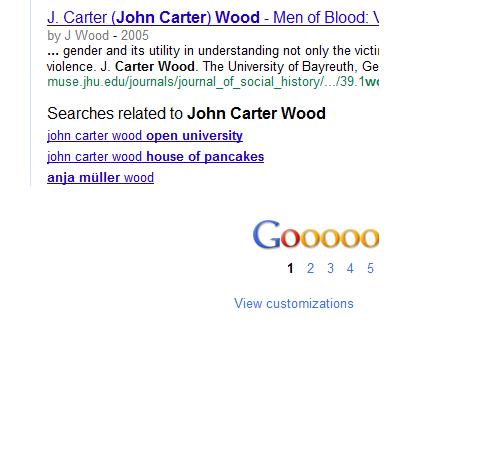
I have to say, I neither have, nor have ever had, any particular commercial relationship with any 'house of pancakes'.
However, just personally, I'm a big fan of IHOP going way back.
How Google would know this, however, is beyond me.
Is there a Muslim sisterhood, too?
In The Guardian today, popular Lacanian Slavoj Z. contemplates on the "miracle of Tahrir Square." To explain the revolutionary rupture that in his view accompanies the collapse of Mubarak's regime, he makes a troubling comparison:
How long, I wonder, until the veil will become mandatory for Egyptian women, how long until women who refuse to obey it will be stuck in a bag and machine-gunned?
In Shah of Shahs, a classic account of the Khomeini revolution, Ryszard Kapuscincki located the precise moment of this rupture: at a Tehran crossroads, a single demonstrator refused to budge when a policeman shouted at him to move, and the embarrassed policeman withdrew; within hours, all Tehran knew about this incident, and although street fights went on for weeks, everyone somehow knew the game was over.I, too have been thinking a lot about "the Khomeini revolution" these past weeks, though I guess in a somewhat more defeatist way. Slavoj ends his piece by warning against the dangers of realpolitik, apparently choosing to forget how often in human history revolutionary enthusiasm has ended in slaughter. I kind of like realpolitik, especially if it is of the calm, pluralistic way of enlightened democracies. I'm an old-fashioned girl, as you know.
How long, I wonder, until the veil will become mandatory for Egyptian women, how long until women who refuse to obey it will be stuck in a bag and machine-gunned?
Monday, February 07, 2011
Ixnay on the azi-Nay
We're still a bit sunk in the work-related grind at the moment, hence the light blogging.
And I'm aware that the following video isn't very new.
But I certainly enjoyed it.
Sometime soon our Will to Blog will return.
But until then: who is this 'Gerr-bels' person with whom these commentators are so obsessed?
And I'm aware that the following video isn't very new.
But I certainly enjoyed it.
| The Daily Show With Jon Stewart | Mon - Thurs 11p / 10c | |||
| 24-Hour Nazi Party People | ||||
| ||||
Sometime soon our Will to Blog will return.
But until then: who is this 'Gerr-bels' person with whom these commentators are so obsessed?
Saturday, January 29, 2011
Money makes the wheels on the world go round
Thanks to a Christmas gift, this has been on the obsessive MP3-Player rotation for the last few weeks:
Just wanted to share.
Just wanted to share.
Friday, January 28, 2011
Thoughts on the naked woman in the shower
I wouldn't want to necessarily endorse anything else in this essay from Slavoj Žižek, but I quite liked this passage:
Politics here or there, that's a distinction I feel I can approve of.
We are often told that privacy is disappearing, that the most intimate secrets are open to public probing. But the reality is the opposite: what is effectively disappearing is public space, with its attendant dignity. Cases abound in our daily lives in which not telling all is the proper thing to do. In Baisers volés, Delphine Seyrig explains to her young lover the difference between politeness and tact: ‘Imagine you inadvertently enter a bathroom where a woman is standing naked under the shower. Politeness requires that you quickly close the door and say, “Pardon, Madame!”, whereas tact would be to quickly close the door and say: “Pardon, Monsieur!”’ It is only in the second case, by pretending not to have seen enough even to make out the sex of the person under the shower, that one displays true tact.
Politics here or there, that's a distinction I feel I can approve of.
Remember my old home, haven't forgotten yet. What happens on the day when I forget?
John Darnielle and "Enoch 18:14".
Very nice.
There are worse ways to end the week.
Very nice.
There are worse ways to end the week.
Wednesday, January 26, 2011
Your kōan for the week
A student, looking for pointers on preparing for the end-of-course exam, asks:
Priceless.
The answer, if you're wondering, did not do the question justice and was of a largely practical nature.
I understand everything, but what should I know?
Priceless.
The answer, if you're wondering, did not do the question justice and was of a largely practical nature.
Apt Music
Catching this song on the radio today I was struck by how - in the right light and from the right angle - David Byrne sounds a little like Tom Petty. Though not so much in this live version:
David Byrne, "Life is Long"
Dedicated to my bro' and his shite genes.
David Byrne, "Life is Long"
Dedicated to my bro' and his shite genes.
Monday, January 17, 2011
Good morning Britain
Quite good stuff, as is to be expected, from Charlie Brooker today:
I find that the point at which politicians start droning on about about the sacrifices of ordinary people who...uh...get up and go to work is essentially the point at which they might as well admit that they really don't have anything useful to contribute to the debate.
To any debate.
It's rather equivalent to defending your policy by saying 'think of the children', i.e., an admission of intellectual bankruptcy.
Although I have to say Nick Clegg has suprised me in at least one way: I never thought I'd find him more embarrassing than David Cameron.
Other than being positively disposed towards Germany, I can't say that Nick has much going for him these days.
And, given that he's in some way tarnishing us Germans by association with his silly pandering to Sun readers, I think he's best start Mentioning the War pretty soon, so as to save us some embarrassment.
"There are millions of people in Alarm Clock Britain," Clegg writes. "People, like Sun readers, who have to get up every morning and work hard to get on in life."
Basically, Alarm Clock Britain consists of people who use alarm clocks. That counts me out, because I wake each morning to the sound of my own despairing screams. Which I guess makes me part of Scream Wake Britain – a demographic Clegg has chosen to ignore.
I find that the point at which politicians start droning on about about the sacrifices of ordinary people who...uh...get up and go to work is essentially the point at which they might as well admit that they really don't have anything useful to contribute to the debate.
To any debate.
It's rather equivalent to defending your policy by saying 'think of the children', i.e., an admission of intellectual bankruptcy.
Although I have to say Nick Clegg has suprised me in at least one way: I never thought I'd find him more embarrassing than David Cameron.
Other than being positively disposed towards Germany, I can't say that Nick has much going for him these days.
And, given that he's in some way tarnishing us Germans by association with his silly pandering to Sun readers, I think he's best start Mentioning the War pretty soon, so as to save us some embarrassment.
Saturday, January 15, 2011
Red sky at night...
This picture does only rudimentary justice to the beauty of the sunset currently going on in front of our house.
But even so, I thought it was worth sharing.
 Wishing you all a good Wochenende.
But even so, I thought it was worth sharing.

Friday, January 14, 2011
Bird of the Day
Although, as you might know, there is a great love for the Common Redstart (Phoenicurus phoenicurus) in this here household, we are of course aware that there's plenty of other sweet birds in the skies around Château Pudding. Like for instance Aegithalos caudatus, aka the Long-tailed Tit:
 Via.
Now just imagine a whole posse of these cute little snowballs (with tails) frolicking in amidst the bare branches of a wild rose bush, like the ones I saw this morning when out running.
Coming home I did a little pre-weekend research and decided that the long-tailed tit was even sweeter than I had imagined. They're not only very sociable animals, who tend to muck about in flocks of around 20 or so individuals. It also seems that they have their collective life sorted out quite splendidly.
For instance, this marvellous species has an admirable albeit complicated sleep ritual (depending on whether it's winter or summer), involving (in the cold months) mutual preening, pseudo courtship rituals and collective cuddling. This is from the German Wikipedia entry (which I can't be asked to translate):
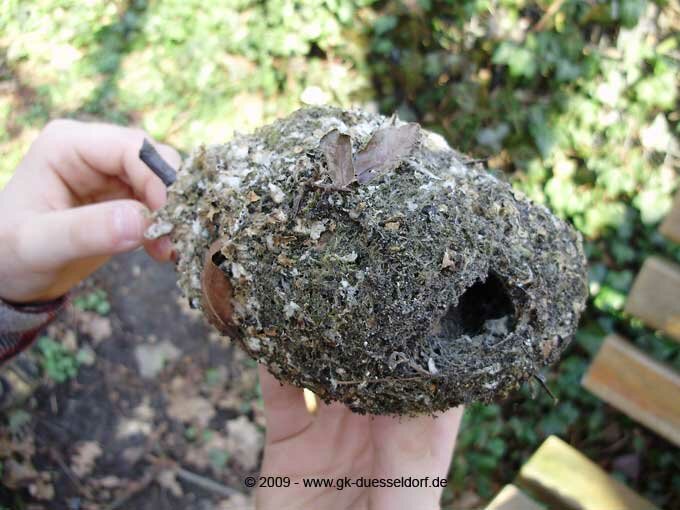
They're also extremely capable architects:
 Via.
 Via.
Now just imagine a whole posse of these cute little snowballs (with tails) frolicking in amidst the bare branches of a wild rose bush, like the ones I saw this morning when out running.
Coming home I did a little pre-weekend research and decided that the long-tailed tit was even sweeter than I had imagined. They're not only very sociable animals, who tend to muck about in flocks of around 20 or so individuals. It also seems that they have their collective life sorted out quite splendidly.
For instance, this marvellous species has an admirable albeit complicated sleep ritual (depending on whether it's winter or summer), involving (in the cold months) mutual preening, pseudo courtship rituals and collective cuddling. This is from the German Wikipedia entry (which I can't be asked to translate):
As John would say: "Now that's civilisation."Innerhalb der Winterschwärme wird auch gemeinsam in eng aneinander geschmiegten Schlafgesellschaften geschlafen, was eine größere Widerstandsfähigkeit gegen besonders niedrige Temperaturen ermöglicht. Die Schlafplätze liegen meist in dichtem Gebüsch in 1–10 m Höhe. Der Schlafplatz wird gezielt angeflogen und die Individuen des Schwarms sammeln sich in der Nähe des Schlafzweiges. Dann wird in einer ritualisierten Handlung ähnlich der Balz die Individualdistanz überwunden. Zwei Individuen lassen sich auf dem Schlafzweig nieder und rutschen hin und her. Nach dem Zusammenrücken schauen sie voneinander weg und putzen sich. Dann fliegen weitere Individuen in die Mitte. Die Bildung der Reihe, in der die Ranghöchsten in der Mitte sitzen, erfolgt unter leisem Zwitschern. Bisweilen wird der Vorgang durch noch aggressive Individuen gestört und wird von neuem begonnen. Er dauert daher meist bis zu 30 Minuten. Die Schwänze der aufgereihten Vögel zeigen am Ende in unterschiedliche Richtungen, manchmal wird auch eine Kugel mit nach außen gerichteten Schwänzen gebildet. Am Morgen wird die Versammlung ohne weitere Zeremonie aufgelöst.
They're also extremely capable architects:
 Via.
Wednesday, January 12, 2011
Political Dyscourse
Well, there we are: for anyone who thought that the recent terrible events in Arizona would lead to some serious soul searching and an improvement in the climate of American political discussion, I would suggest that Sarah Palin's latest thoughtful contribution to the matter pounds a pretty hefty nail in that hope's coffin.
Not that others weren't already busily hammerin' away.
(I was not one of those optimists; however, a load of work -- combined with a general fury and disgust at the whole dreadful thing -- has kept me from commenting, so you'll just have to take my word on it.)
For what it's worth: a couple of comments that I did think worthwhile: MGK and PZ.
Now, I'm going to return to thinking about something that doesn't make me want to throw up.
[UPDATE] This comment from Adam Serwer is also good.
[UPDATE] And this, via Boing Boing too (just surveying, mind):


Subscribe to:
Posts (Atom)