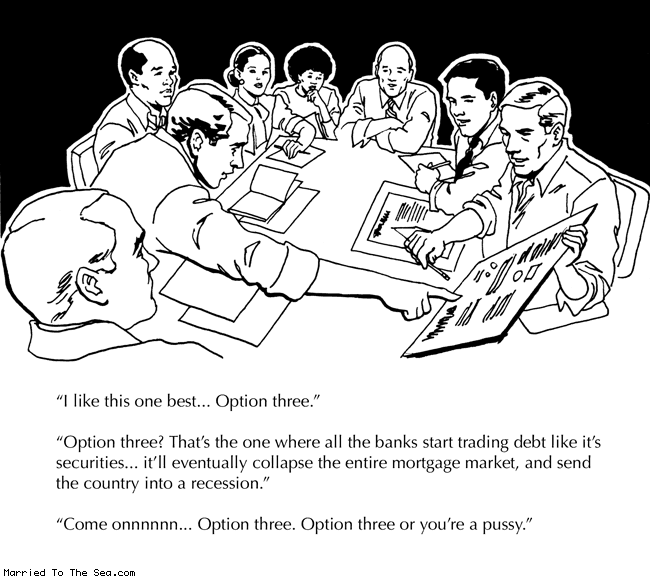
As someone who pretty regularly reads the German financial press (well, at least the FAZ and the now late-and-much-lamented Financial Times Germany), there were moments last year when I felt like I had stumbled into an alternate universe when visiting Britain (which--for research reasons--we often did).
The euro crisis, of course, was a press obsession both (here) in Germany and (there) in Britain, but what struck me was the confident expectation auf der Insel (tinged with more than a bit of Shadenfreude in many cases) that the single currency was doomed.
'So', I remember a friend in London saying, 'how do you feel about the euro breaking apart?'
My statement that it was a bit premature to say that and suggestion that eurozone governments--though not exactly experiencing their finest hour--would probably find a way of muddling through in classic EU fashion, were greeted with scepticism.
Thus, I had to laugh yesterday when we heard a radio report on the way back from work in which at least one financial analyst expressed concerns that the euro was now too strong, potentially weakening European exports.
And -- though I'm far from an expert on this and am well aware that problems remain (and that the whole thing may, indeed, some day fly apart) -- I thought that Philip Stevens's article in the Financial Times about Anglo-Saxon gloom-mongering was well worth reading.
The end point for the eurozone looks likely to be a much tighter economic union but one falling short of political federalism. Nemat Shafik, the deputy managing director of the IMF, put it well at a recent gathering in Paris of the Franco-British Colloque. Europe’s destination probably lay in the “muddy middle of variable geometry and hybrids between federal and intergovernmental solutions”.
The euro still confronts formidable political and economic challenges – though those who blame everything on the single currency must also explain why Britain is in a bigger mess. No one can be sure the currency will survive in perpetuity. History says that monetary unions often break up. But at least we know now that the politicians will not give up without a pretty ferocious fight.
I'm not familiar with the writings of Clyde Prestowitz, but I found at least three things to like about his recent comments at Foreign Policy on the World Economic Forum in Davos ('Clueless in Davos').
First: he uses the word 'glitteratus', and I've rather a soft spot for the underachiving singular forms of words that are almost always used in the plural (e.g. 'graffito').
Second: he makes reference to the 'gnomes of Zurich', a nickname for Swiss bankers that I first encountered as a teenager while playing Illuminati and which has since stuck in my mind, though I have the feeling it's been largely forgotten. What I never knew (and was inspired by this reference to discover) was that the phrase apparently originated via discussions among British Labour politicians in the 1960s.
Third: he has a rather jaundiced view of the Davos lifestyle, one that jibes well with our own personal experience of the town at the beginning of last month.
Yet, despite his anti-charisma, [WEF organiser Klaus] Schwab has managed to persuade a large number of the world's top CEOs, politicians, academics, media stars, and bureaucrats that they have to be in a cramped, second rate hotel in a cold Swiss village with mediocre skiing and food every year during the bridge weekend between January and February.
Though I imagine that the kind of 'cramped, second rate hotel' being shared by most of these Davos men and women -- however cramped and second rate -- is in a different class than ours was. (Where the ambience was more 'sleepless in Davos' than 'clueless in Davos'.)
Though, as I noted, there are very nice things about the place.
Prospective Republican candidate for president Herman Cain (who is apparently leading the party's polls), responding to a question at last night's debate about how he would respond in the face of a possible European financial meltdown:
"Just like a dollar must be a dollar when we wake up in the morning,
just like 60 minutes is in an hour, a dollar must be a dollar."
I note briefly that the Communist firebrands at The Economist--citing a Congressional Budget Office report--have chimed in on one aspect of the 'Occupy' protests: the 'we are the 99%' slogan.
Their comment:
"Whatever the cause, the data are powerful because they tend to support two prejudices. First, that a system that works well for the very richest has delivered returns on labour that are disappointing for everyone else. Second, that the people at the top have made out like bandits over the past few decades, and that now everyone else must pick up the bill. Of course it is a little more complicated than that. But this downturn ought to test the normally warm feelings in America of the 99% towards the 1%."
And if there's anything I like, ladies and gents, it's having my prejudices supported.
Thank you, Economist, for bringing so much joy to my lunch break.
All told, Obama-era choices account for about $1.7 trillion in new debt, according to a separate Washington Post analysis of CBO data over the past decade. Bush-era policies, meanwhile, account for more than $7 trillion and are a major contributor to the trillion-dollar annual budget deficits that are dominating the political debate.
Of course, once we're in a world where the word 'only' and the phrase '$1.7 trillion in new debt' can be brought into close relationship with one another, I admit that I'm a bit out of my depth, counting-wise.
Still, I can see the difference between 1.7 and 7.
Food for thought in considering the current debate.
The sociology of the Chinese elite, read through German automobiles at the Wall Street Journal:
According to Yang Jian, managing editor of Automotive News China, a trade magazine based in Shanghai, BMW consumers are “typically young business people — entrepreneurs who have made a lot of money.”
Sounds obvious, until you compare to the brand’s competition: BMW is the No. 2 luxury-car brand in China — it sold 102,916 units in the first 10 months of the year, according to data from market-research firm J.D. Power & Associates. The top brand is Audi, with 172,180 units sold through October. The Audi demographic consists mostly of government officials, the leading consumers of luxury cars in China. The third most-popular brand in China? Mercedes-Benz, which sold 90,306 units from January to October — its models are the preferred choice of older businessmen and government officials in higher positions.
A man brought his German-born neighbour close to tears by twice calling her a schweinhund, a court heard yesterday.
...which suffers only the slight drawback that a knowledge of German that goes beyond comic books may be essential: the correct word is Schweinehund.
Don't forget that little linking 'e', and always remember that all German nouns, especially the insulting ones, should be capitalised. (Thanks to The Wife for the link.)
It's about the impact of the Global Financial Worldwide Totally Scary Economic Thingy (or whatever) on this here place I call home.
So far as it goes, I think Ashley is correct--though not entirely original--in saying that said economic impact is going to be...wait for it...quite severe.
Fair enough.
But he manages the very strange feat of suggesting that key characteristics of the German economy (Making High-Quality Things That The World Wants To Buy) and of the German population more generally (Being Somewhat Cautious With Their Money and Not Going Crazily Into Debt) are not the sensible and virtuous things you might have thought and are...instead...somehow...deeply shameful.
I think he should have just come out and used the word Schweinehund.
There I was thinking that financial melt-down, increasing unemployment and worsening poverty were going to be the worst parts of the ever-more-frightening economic crisis now gathering pace.
No: it seems we're also going to have cope with the resurgent popularity of Ayn Rand's long-winded, petulant, and frankly laughable novel, Atlas Shrugged, also known in these parts as The Worst Book Ever Written.
Apparently, some people are finding it prophetic regarding the economic catastrophe. This is odd. The story, after all, revolves around a small cadre of genius entrepreneurs confronted by a World of Parasite Losers, most sinisterly embodied by a government that produces nothing but incompetence and enforces only inefficiency. Confronted by over-regulation and exorbitant taxes, our heroes essentially organise a capital strike that brings down the corrupt society.
Perhaps those who see the book as a template for the real world haven't actually read it (claiming to have read books you haven't is, after all, as recent surveys have suggested, all too common), since here in the real world it would be the former Wall Street masters of the universe--after decades of reductions in taxes and lightening state regulation--who brought about this collapse, taking the savings, profits, capital and potential credit of a lot of hard-working, productive people--and even whole nations--with them.
Maybe it's just that those who are praising the book have a greater capacity for irony than I have given them credit for.
I doubt it, though. The key psychological trait I've noticed with admirers of Rand's work is their natural inclination to identify with the swaggering, self-absorbed Übermenschen who populate her novels. (The fact that some of said admirers were students attending state-funded universities using state-subsidised grants or loans has never seemed to quiet their rage at the state for some reason, but this is by the by.)
Their capacity for self-aggrandizement is inevitably as voluminous and tiresome as Rand's prose.
Out in the banking world, as you might imagine, Rand has had no shortage of fans, and my favourite recent Rand-related anecdote comes from the story of BB&T Corp., as related by va at Whiskey Fire:
So, I had read this New York Times article last week and was unsure about how to put my feelings about it into words.
Ezra does better:
The New York Timesarticle on how hard it will be for senior executives to live in New York on $500,000 is the sort of thing that makes me want to burn this rotted society to the ground and salt the earth atop which it once stood.
The Washington Post has a story on former Federal Reserve Chairman Alan Greenspan:
In testimony before the House Committee on Oversight and Government Reform, Greenspan said that, as a result of the current situation, the United States is heading for a "significant rise in layoffs and unemployment" and a continued downturn in home values as the world works through a crisis that is "broader than anything I could have imagined."
Greenspan, who called the current financial crisis a "once-in-a-century credit tsunami," said that he remained "in a state of shocked disbelief" that banks and investment firms did not do a better job of analyzing the risks involved with investing in home mortgages extended to less creditworthy borrowers.
Greenspan's impression of Casablanca's Captain Renault ("I'm shocked, shocked to find that gambling is going on in here!") in responding to the financial crisis would be amusing, if he hadn't helped to create the conditions for it.
As Dale points out:
To call Alan Greenspan a true believer in the god of market fundamentalism would be akin to calling Moses a true believer in the god of the Old Testament -- he was on the scene as the plates were etched, inhaling the very vapors rising from the burning bush.
Whatever Greenspan inhaled, coming down from that trip is a definite bummer.
Pressed by Waxman, Greenspan conceded a more serious flaw in his own philosophy that unfettered free markets sit at the root of a superior economy.
"I made a mistake in presuming that the self-interests of organizations, specifically banks and others, were such as that they were best capable of protecting their own shareholders and their equity in the firms," Greenspan said.
Waxman pushed the former Fed chief, who left office in 2006, to clarify his explanation.
"In other words, you found that your view of the world, your ideology, was not right, it was not working," Waxman said.
"Absolutely, precisely," Greenspan replied. "You know, that's precisely the reason I was shocked, because I have been going for 40 years or more with very considerable evidence that it was working exceptionally well."
Along with the primer that I recommended on the background to how several hundred billion dollars (euros, pounds, yen, whatever...) have rapidly evaporated, I suggest you peruse posts by Andrew, Francis and Shuggy.
If you want to escape thinking about it, I recommend listening to Juana Molina over and over again, until the fear subsides.
I received, coincidentally, an e-mail yesterday from the institution I work for that sought to reassure me about its financial situation and to emphasise that I will continue to be paid as normal.
Which is reassuring.
Except for the fact that they felt they needed to reassure me.
[UPDATE] Dale points us to a sequel, of sorts, of the 'This American Life' radio report that I recommended previously. I haven't listened to it yet, but the title, 'Another Frightening Show About the Economy', is certainly encouraging.
It is currently available FREE for download.
And 'free' is sounding increasingly good.
[UPDATED UPDATE] Oh my...now even the cats are suffering! (At least, as previously mentioned here, they might make a possible -- if substandard -- food source. If it's good enough for Peru....)
Just to continue (briefly this time) the thoughts I expressed a couple of days ago about the international financial crisis (and there were a few more signs yesterday and today -- in Britain, Iceland and Germany for example -- about just how international this is becoming): An article at the New York Times led me to an excellent episode of 'This American Life', a radio programme produced by Chicago public radio.
'The Giant Pool of Money' was broadcast back in May, but it offers one of the few clear explanations that I've seen of the various factors that came together over the last several years to give us all the wonderful spectacle of the shit hitting the financial fan.
(The original broadcast can be downloaded for a small fee, but -- perhaps for the more credit-crunched among you -- a free transcript is also available. That is the source of the quotes that follow.)
One of the strengths of the show is that it is largely based on interviews with actual people at all levels in the long chain of financial relationships that led to this crisis.
We meet, for instance, Clarence, who received a $540,000 loan against his house:
Alex Blumberg: And you basically borrowed that from the bank and they didn’t check your income?
Clarence Nathan: Right. It’s a no-income verification loan. They don't do that. It's almost like you pass a guy in the street and say: lend me 540,000 dollars? He says, what do you do? Hey, I got a job. OK. It seems that casual even though there are a lot of papers that get filled out and stuff flies all over with the faxed and emails. Essentially, that's ... that the process.
Alex Blumberg: Would you have loaned you the money?
Clarence Nathan: I wouldn't have loaned me the money. And nobody that I know would have loaned me the money. I know guys who are criminals who wouldn't loan me that and they break your knee-caps. I don’t know why the bank did it. I’m serious ... 540 thousand dollars to a person with bad credit.
The show also introduces us to an enormous pile of money -- about $70 trillion worldwide -- that was desperately looking for something to do and was bored with piddling returns on US Treasury bonds.
Now, how this incomprehensible sum of money led to Clarence getting a loan he had no business being anywhere near is a long story and involves meeting a few other people.
Like Glen, for example, who -- fresh out of college -- was making about $75-100,000 a month buying and selling these toxic mortgages.
And, apparently, spending it as fast as he could make it:
We ordered 3, 4 bottles of Cristal at $1000 per bottle. They bring it out, you know hey're walking through the crowd, they're holding the bottles over their heads. There's fire crackers , sparklers. You know, the little cocktail waitresses. You know so you order 3 or 4 bottles of those and they’re walking through the crowd and everyone’s like: Whoa, who's the cool guys? We were the cool guys.
Oh yes, absolutely. Very cool. Can I eat lunch at the cool kids table too, Glen? Oh, I'm sorry, you're not allowed to sit there yourself any more, are you?
Alex Blumberg: So give me your situation now. Can you pay all your bills now?
Glen Pizzolorusso: Not really. I borrowed some money from friends...from dad. Living in my house right now, we’re working with the bank to try to avoid foreclosure. At this point I’m dealing with an attorney. Trying to figure out if it just makes sense for me to walk away from the house.
Alex Blumberg: And have you made mortgage payments?
Glen Pizzolorusso: No. No.
That's right: after making millions dealing in mortgages of questionable value, Glen can't pay his own mortgage any more.
Anyway, Clarence and Glen obviously lived in different worlds, and they never met each other.
But the show's makers deserve a great deal of credit for managing to explain how people like them -- at different points in a long chain of responsibility -- made it extremely likely that the world economy is going to become a chilly place for at least the medium-term future.
How chilly?
In summing up, Blumberg downplays the more horrifying visions of a return to a 1930s-style depression:
That talk seems to have faded and there's more talk that the next few years will feel like the 1970s. There are lots of technical differences between this crisis and Jimmy Carter's malaise. But for the average person, it could feel the same. It's not an out-and-out depression. Everything's just kind of crappy. And not just in housing or banking but for the economy as a whole. It’s barely growing. There aren't a lot of new businesses, new jobs. Unemployment keeps creeping up. We're just sort of stuck, in neutral, for a while.
Anyone under, say, 45 probably doesn't remember that 1970's malaise too well. Anyone under 30 has barely known a US economy that wasn't growing. Now there's a decent chance we'll all get to see what life felt like in the '70s. Which isn't great. It's pretty bad, actually. Unless you're comparing it to the 1930’s.
And it maybe tells you a lot about the situation (or maybe just something about me) that 'everything's just kind of crappy' sounds somehow encouraging.
Till you remember that the report was completed back in May.
So far, unlike The Wife, I've managed to maintain at least a shred of the post-vacation Zen with which we returned from France.
This is partly because I have consciously been avoiding news that might disturb my equilibrium. I have managed, for example, to escape reading anything lengthy about Sarah Palin in, oh, about three weeks now. Furthermore, the headlines about the election that I have tentatively perused have lately been signalling that things just might actually be going pretty well on that score.
And I've been listening to a lot of death metal recently, which, curiously enough, always seems to leave me with a deep sense of inner tranquilty.
These factors all might play a role. But I suspect my relative well-being is also partly down to the fact that the main political issue I've spent any time reading about in the last few days has led to more befuddlement than -- at least so far -- blind rage.
I'm referring to the financial...crash...bailout...collapse...thingy.
Don't get me wrong: I'm quite clear that there are plenty of reasons for anger here and lots of people who I will decide, I am sure, need a good kicking.
All in good time.
But it's occurred to me that I'm still a bit...confused about just what, exactly, it is that's in the process of collapsing and, precisely, what that proposed $700 billion is going to be used for in the interests of preventing the Utter and Complete Meltdown of the American Economy.
I mean, it helps if you can attach an image to a economic crisis. Tulipmania was about, well, tulips, and even if the value of a tulip is a pretty abstract thing, you still know something about the rational core of the madness that resulted. The Great Depression? Yep, have plenty of visuals on that, dustbowls and all the rest. The oil crisis of the 70s? I have personal memories of 'no gas' signs and waiting in long lines to tank up the car. The villains were clear: bearded men with sunglasses and funny headgear. The dotcom bubble? No problem. I knew what a browser was and the villains were smirking 23-year-olds who burned through billions of semi-imaginary dollars based on semi-imaginary business plans.
But I'm trying to visualise a 'collateralized debt obligation' or a 'credit-default swap' (more on these below) and I just...can't get there.
And I don't like admitting that kind of confusion, since, you know, I like to think that I have a reasonably well-informed understanding of how the world works.
But, on this issue, I have to say that my grasp of things is only a bit sketchy.
On that score, though, it's becoming clear to me that I'm not the only one.
At the New York Times today, Vikas Bajaj has an interesting little article with the intriguing title 'What's all this stuff worth?'
And, you know, it turns out that answering that question is a bit more difficult than you might think.
Vikas, over to you:
Consider the Bear Stearns Alt-A Trust 2006-7, a $1.3 billion drop in the sea of risky loans. Here’s how it worked:
As the credit bubble grew in 2006, Bear Stearns, then one of the leading mortgage traders on Wall Street, bought 2,871 mortgages from lenders like the Countrywide Financial Corporation.
The mortgages, with an average size of about $450,000, were Alt-A loans — the kind often referred to as liar loans, because lenders made them without the usual documentation to verify borrowers’ incomes or savings.
Let's just pause here for a brief moment. Just for a measly few seconds.
Please just consider that last sentence, the one in which it is pointed out that lenders gave people mortgages worth an average of nearly a half-million dollars without even checking how much they earned or how much money they had?
Is this for real?
Because if it is, I can only say: What--please pardon my French (you know, I've been spending some time there)--the fuck?!
A few years ago (when things were still going generally well in the banking world, mind) our mortgage application (for, ahem, a lot less than the above-mentioned average) to buy our house in Germany required that we submit ourselves to bank scrutiny that felt like the financial equivalent of a colonoscopy.
You mean in America, we could've gotten more than twice as much without even having to prove we could pay it back?
Awesome.
Ok, let's continue...
Bear Stearns bundled the loans into 37 different kinds of bonds, ranked by varying levels of risk, for sale to investment banks, hedge funds and insurance companies.
If any of the mortgages went bad — and, it turned out, many did — the bonds at the bottom of the pecking order would suffer losses first, followed by the next lowest, and so on up the chain. By one measure, the Bear Stearns Alt-A Trust 2006-7 has performed well: It has suffered losses of about 1.6 percent. Of those loans, 778 have been paid off or moved through the foreclosure process.
But by many other measures, it’s a toxic portfolio. Of the 2,093 loans that remain, 23 percent are delinquent or in foreclosure, according to Bloomberg News data. Initially rated triple-A, the most senior of the securities were downgraded to near junk bond status last week. Valuing mortgage bonds, even the safest variety, requires guesstimates: How many homeowners will fall behind on their mortgages? If the bank forecloses, what will the homes sell for? Investments like the Bear Stearns securities are almost certain to lose value as long as home prices keep falling.
Ah, 'bundled' is such a nice cosy word, isn't it? It doesn't seem quite the right word for what's been described here, which seems--if I have this right, and there's no guarantee that I do--to involve something like this:
You have a bunch of dodgy loans, which have been repackaged as a shiny new financial product mixed up with a bunch of other products conjured up via a similar kind of investment bank voodoo. This tasty cocktail has thereafter been blessed by a rating agency with the label 'triple A' based on 'guesstimates' and sold to people who think they are making a solid 'investment'.
Ah. Yes.
I am, as I've said, a Fucking Moron when it comes to complicated finances: but I can't for the life of me see how this was a good idea.
But it gets better:
The Bear Stearns bonds are just one example of the kind of assets the government could buy, and they are by no means the most complicated of the lot. Wall Street took bonds like those of Bear Stearns and bundled and rebundled them into even trickier investments known as collateralized debt obligations, or C.D.O.’s
“No two pieces of paper are the same,” said Mr. Feltus of Pioneer Investments.
'Bundled and rebundled'. Excellent!
Now, I suppose it's obvious that while this might all seem terribly complex to your average person who doesn't know all that much about economics, like yours truly (or, say, by his own admission, John 'I have to skip the debate so I can go off and singlehandedly solve the crisis I had a role in creating' McCain), clearly the people who were, you know, running the system knew what was going on.
Didn't they?
Yes, you would think that wouldn't you?
However, in a flabbergasting article that I read in the International Herald Tribune while still on vacation, it seems that many of them did not know what it was they were selling.
In Nelson D. Schwartz's 'A crisis too complex for easy fixes' (the title in the print version I bought on the Normandy coast was the far more direct 'Complexity of trading overwhelmed the traders', but it might be that that the more critical title was intended only for foreign distribution in communist countries like France) we find suggestions that a lot of the people -- even the senior people -- casting their kooky financial magic spells didn't really know what kind of dark forces they were meddling with:
In some ways, Wall Street suffers from a generation gap. At 62, Richard Fuld, the head of Lehman Brothers, had ridden out everything from the oil shocks of the 1970s to the Russian debt default and Asian economic flu in 1998. But in recent years, his firm and other Wall Street giants derived an ever-increasing share of profits from products that barely existed a decade ago, like credit-default swaps. Essentially insurance on debt, the market for credit-default swaps has ballooned from $900 billion in 2001 to a nearly unimaginable $45.5 trillion now.
Um, yes, nearly unimaginable. Anyway...
Jamie Cawley, a veteran player in the credit-default swaps market, says he doubts whether the older chiefs of the firms who profited from these products, or the young traders who specialized in them, fully understood the implications of what they were doing.
"Had they understood the implications, we wouldn't be where we are today," said Cawley, founder and chief executive of IDX Capital. The overriding feeling on Wall Street, he said, was: "Let's make money while the sun shines and worry about the details later."
Aw shucks, that's a great feeling, ain't it? What a bunch of fun!
Tell me: is cocaine still as popular as it once was on Wall Street? Because this sounds like the kind of killer Good Times that would only sound convincing and sensible to a bunch of coked up Harvard Business School grads.
Yes, these are the people to whom we were told we should trust the privatisation of Social Security not all that long ago. I shudder to think what they might have 'rebundled' that into.
And they were being paid so much money for their fine stewardship of the nation's key financial giants...
The compensation of Fuld and other Wall Street chief executives followed a similar trajectory higher during the earlier boom years.
"If you're approving things you don't understand, that's not doing your job," said Jonathan Koppell, director of the Millstein Center for Corporate Governance and Performance at the Yale School of Management. "What are these guys compensated for, if they're checking off things they don't understand?"
"A huge number of directors probably didn't understand what their companies were up to, and it's quite likely at least some of the leaders of these companies didn't fully understand what their employees were doing," he added.
Some of these are, remember, quite possibly those companies that we've been told are 'too big to fail', that have to be rescued by a pretty massive infusion of public money or Economic Life as We Know It will come to a halt.
Two final thoughts on this issue for the moment, as it's nearing bed-time and I'm beginning to feel angry and, you know, I don't want to go to bed angry.
We must end the danger posed by companies that are "too big too fail," that is, companies whose failure would cause systemic harm to the U.S. economy. If a company is too big to fail, it is too big to exist. We need to determine which companies fall in this category and then break them up. Right now, for example, the Bank of America, the nation's largest depository institution, has absorbed Countrywide, the nation's largest mortgage lender, and Merrill Lynch, the nation's largest brokerage house. We should not be trying to solve the current financial crisis by creating even larger, more powerful institutions. Their failure could cause even more harm to the entire economy.
To which I can only add, as Sarah Palin might put it, yup.
If the federal government siphoned off Florida's gross domestic product, we could cover the bailout. Invading the Netherlands might be advisable—that nation's GDP was $768.7 billion last year. Of course, invasions cost a lot of money. Back in 2003, the Bush administration told Congress that the Iraq war would cost between $60 billion and $100 billion, but it's estimated that, so far, we've spent about $600 billion. Should the Treasury receive authority from Congress to borrow $700 billion, the national debt will rise by only about 7 percent. Right now, it's sitting at $9.6 trillion.
A variety of other measures are in the article. Whether it's a lot of money or a nearly unimaginable amount of money, I leave to your own discretion, dear reader.
So, maybe, considering the scale of this thing and the apparent fact that a lot of people who were supposed to understand it (and who were paid substantial sums of money on that assumption) were asleep at the wheel, I don't feel so bad.
I mean, I have to reveal my ignorance only to that select circle of readers of this humble blog.
Sarah Palin has to do it on national television.
(Via Dale and Andrew: great minds thinking alike tonight)
Finally, in the course of writing what has turned out to be a much longer post than I intended at the start (if you're still here, well, thanks for sticking around for the ride), it has occurred to me that the word 'bundling' -- long before it was adopted by Wall Street banks as a means of recycling toxic waste -- was a term used by Robert A. Heinlein in The Moon is a Harsh Mistress (one of my favourite science fiction novels) as a futuristic slang term for, ahem, sexual intercourse.
Seeing that the financial system appears thoroughly fucked, this somehow seemed appropriate.
At least enough to inspire the title of a blog post.
It seems that some real change is afoot, as David Leonhardt points out in the New York Times, in comments on the declining sales of the F-series pickup in the US:
For more than two decades, Ford’s F-series pickup trucks have been the most popular line of vehicles in the country, selling more every year than any sedan, station wagon or S.U.V., foreign or domestic. But F-series sales have dropped more than 30 percent since last spring.
Last month, according to the new sales numbers released on Tuesday, the Toyota Corolla and Camry and the Honda Civic and Accord all surged past the F-series. It was the first month since December 1992 that a car — not a truck — was the country’s top-selling vehicle. The world doesn’t seem to have come to an end as a result.
Leonhardt looks at the mid-term comparative costs of buying and operating different vehicles across five-years, emphasising how much concentrating on fuel efficiency can save you:
While the F-250 costs $100,000 and a fully loaded F-150 — the better-known, smaller Ford pickup — costs about $70,000, a Ford Focus still costs less than $40,000 over five years. A Honda Civic Hybrid does, too. A Toyota Prius costs only a little more. A Subaru Outback station wagon runs $50,000 or so.
To put this in perspective, the difference between a Focus and an F-250 over five years is $60,000. The annual pretax income of a typical family in this country is also about $60,000. So choosing a F-250 over a Focus is like volunteering for a 20 percent pay cut. The relative resale values might cushion the blow a little, but not much.
The primary beneficiaries of this shift seem to be Toyota and Honda, who, I think, have pretty much dominated the small car market in the US for decades.
I wonder: is there an opportunity here for European car makers to also expand in the US?
Even...dare one say it...the French? Even if previous efforts in this direction (think 'Le Car', better known to European readers as the Renault 5) have been less than successful.
This was despite the excellent ad campaign for 'Le Car'. (Link leads to an extraordinary ad, on which embedding has sadly been disabled. But take a look. You'll be glad you did.)
I mean, how could Americans have resisted back in 1981?
In the mid-90s, a grad-school roommate had one of these, in the classic yellow colour with 'Le Car' written on the side, as I recall. It was, by that point, about 15 years old, I think, and he continued driving it for about 4 months even after the clutch went out.
(Some American readers may no longer know what a 'clutch' is. Explanation here.)
When I mention to Americans what make of car we have, most seem to think I'm suffering from some kind of speech impediment when I respond.
For a change, I don't think that's a result of my poor French pronunciation. (I've been told by one friend that I now have a German accent when I speak French, which is apparently quite comical.) Rather, Citroën stopped selling cars in America in the 1970s.
Interestingly enough, they are now promoting themselves in Britain by pretending to be German.
(I, actually, find the C5 to be sort of dull: the C4 is much more interesting.)
I'm a bit preoccupied with work-related writing and data-entry (as I have embarked on my first ever foray into quantitative history...fortunately, I'm working with someone who knows his stuff...) as well as fighting off an illness that seems to have encased my neurons in some kind of dense, wool-like substance.
Hence the lack of my accustomed level of verbiage on this humble blog.
Not to worry, that will no doubt change soon.
Till then, I can recommend this interesting essay by John Lee (via) on the potential (or lack thereof) for democratic change in China in the wake of its economic reforms over the last few decades.
Lee observes:
To be sure, we have no choice but to continue to engage with China in the hope that continued economic reforms and rising prosperity there will eventually lead to political reform. But we should reject the blind and deterministic logic that a rising China will inevitably become a democratic one. Even if we believe that authoritarian China is on the wrong side of history, so far it is doing a good job of defying it.
Why this might be so is helpfully explained by several passages in the piece, such as this one (I have removed the footnotes, which are available in the original essay):
That the middle classes—from the private and public sectors alike—have little appetite for democratic reform is easily explained: they have much to gain from the current political status quo and potentially much to lose should it change.
Eva Bellin observes that state-led development breeds a dependence on the state in capital and labour, and tends to exacerbate inequality. Within one generation, China has gone from being the most equal to the least equal society in Asia. Its Gini coefficient (a measurement of income inequality) is now 0.47, up from 0.16 in the 1970s. There are between fifty million and two hundred million middle-class people (depending on what definition you use), but around one billion people who have missed out on the benefits of economic liberalisation. Much of China’s progress actually occurred from the late 1970s to the mid-1980s. Going by the World Bank’s definition of poverty, 80% of people emerging from it in China did so up to the mid-1980s. Since then, of China’s one billion poor, about four hundred million have seen their disposable incomes stagnate or decline.
I was reminded of something that Francis Sedgemore, referring to comments by Slavoj Žižek, recently pointed out:
capitalism doesn’t always bring democracy. Anyone who thinks otherwise is blind to both history and the reality of the world around them today.
One of the questions that Norm asks contributors to his profile series is 'What philosophical thesis do you think it most important to disseminate?' Like many of the other questions, that's a tough one all right.
The answer I gave -- 'To promote both the use of rational thought and the awareness that people are not fundamentally rational' -- is far from perfect (or even profound) perhaps, but it does more-or-less express what has become a guiding principle of mine.
It has at least the benefit of being both parsimonious and symmetrical, as each side of this particular outlook has a single source:
Do we need to promote rational thought? Yes, why, just look at all the crazy shit people do?!
Are we, deep down, fundamentally rational beings? No, why, just look at all the crazy shit people do?!
What is more, given the sheer volume of said crazy shit, I get to see my beliefs confirmed on a daily basis.
That is nice.
It's helpful now and then, though, to discover that at least some of the views I hold have a more firm grounding in what has succinctly and pithily described as 'earth-logic', something from which all too many people's thinking achieves escape velocity.
Last week, Elizabeth Kolbert had an interesting article in the New Yorker on a related point. In 'What was I thinking?', she looks at a couple of books on research being done on the irrational bases of behaviour. She focuses on 'behavioural economics' in the form of Dan Ariely's book Predictably Irrational: The Hidden Forces that Shape Our Decisions.
I've not read it, but I like the gist of his arguments.
He claims that his experiments, and others like them, reveal the underlying logic to our illogic. “Our irrational behaviors are neither random nor senseless—they are systematic,” he writes. “We all make the same types of mistakes over and over.” So attached are we to certain kinds of errors, he contends, that we are incapable even of recognizing them as errors.
With regard to a somewhat different sphere, 'The Moral Instinct', by Steven Pinker, appeared at the New York Times, summarising a variety of work on the issue of where people's moral beliefs come from. Confronting the assumption that morality is (simply) imposed through learning and imitation, he points to research suggesting a far more intuitive understanding of moral concepts that underlies a large part evaluating right and wrong.
At least a certain portion of culture, then, appears as a result of the effort to find post-hoc rationalisations for what we think anyway. (That certainly explains a lot of blogging...)
Like a lot of Pinker's writing, the article is a mixture of effective summary, brilliant insight and sometimes careless quips. (For instance: I'm not convinced that arguments about the environmental impact of, say, S.U.V.s are necessarily based on personal moral abhorrence about 'over-indulgence'. One does not need moral priggishness to critique personal wastefulness, merely an understanding that individual behaviour multiplied by hundreds of millions of individuals can have an enormous impact.)
Also like a lot of Pinker's writing, it is enormously compelling. He observes:
The science of the moral sense also alerts us to ways in which our psychological makeup can get in the way of our arriving at the most defensible moral conclusions. The moral sense, we are learning, is as vulnerable to illusions as the other senses. It is apt to confuse morality per se with purity, status and conformity. It tends to reframe practical problems as moral crusades and thus see their solution in punitive aggression. It imposes taboos that make certain ideas indiscussible. And it has the nasty habit of always putting the self on the side of the angels.
One of the researchers mentioned by Pinker is Jonathan Haidt. Haidt has a curious article at Edge: 'Moral Psychology and the Misunderstanding of Religion'. I say 'curious', because its first part (up to about page six on the printed version) is a fascinating and convincing look at the intuitive nature of moral judgements and the unconscious causation of most behaviour whereas its second half is a much less convincing critique of 'New Atheism' .
This is one of the best bits, at least with regard to the topic I'm discussing here:
Our brains, like other animal brains, are constantly trying to fine tune and speed up the central decision of all action: approach or avoid. You can't understand the river of fMRI studies on neuroeconomics and decision making without embracing this principle. We have affectively-valenced intuitive reactions to almost everything, particularly to morally relevant stimuli such as gossip or the evening news. Reasoning by its very nature is slow, playing out in seconds.
Studies of everyday reasoning show that we usually use reason to search for evidence to support our initial judgment, which was made in milliseconds. But I do agree with Josh Greene that sometimes we can use controlled processes such as reasoning to override our initial intuitions. I just think this happens rarely, maybe in one or two percent of the hundreds of judgments we make each week. And I do agree with Marc Hauser that these moral intuitions require a lot of computation, which he is unpacking.
Hauser and I mostly disagree on a definitional question: whether this means that "cognition" precedes "emotion." I try never to contrast those terms, because it's all cognition. I think the crucial contrast is between two kinds of cognition: intuitions (which are fast and usually affectively laden) and reasoning (which is slow, cool, and less motivating).
And there's another conclusion that is also important:
The basic idea is that we did not evolve language and reasoning because they helped us to find truth; we evolved these skills because they were useful to their bearers, and among their greatest benefits were reputation management and manipulation. (Emphasis added)
And this, I think is a key point: our psychologies are about use, not truth.
Haidt's article is fairly lengthy, as are the responses to it by David Sloan Wilson, Michael Sherman, Sam Harris, PZ Myers and Marc Hauser. So, this posting is an entirely too brief summary of what that discussion is all about.
Much of that discussion focuses on the much weaker part of Haidt's paper, where he tries to apply his empirical conclusions to the 'New Atheism'.
I'll simply direct you to the responses by Myers and Harris on that topic.
But I also think that Haidt's efforts to link religiosity to the current effort by some people to rehabilitate 'group selection' are unconvincing.
This is bad evolutionary reasoning, and the kind of speculation that ultimately led Gould and Lewontin to have a field day with loose just-so stories. But there is more. Just because there is variation doesn’t mean it will be selected. It has to be heritable variation. One has to show that the belief systems are genetically passed on in some way, or one has to argue for cultural selection, which is an entirely different affair, at least at the level of mechanism and timing of change. I don’t see any evidence that the observed variation in beliefs is heritable in a genetic sense. (Emphasis added)
(Hauser's point about heritability is also germane, of course, to Gregory Clark's recent speculations about the genetic basis of capitalism. I commented here, here, and here.)
It seems clear to me that while Haidt is right to point out the benefits that might accrue to those who are well integrated into their communities, he is mistaking those benefits as being purely religious in nature. (This is partly what Myers rebukes him for.)
Moreover (and this comes out in Sam Harris's response), Haidt seems to be basing his view of religion largely (or maybe even exclusively, as far as his empirical evidence goes) on the relatively contained, civilised, reformed -- in short, tamed -- version that you find in some parts of the modern world and not the less cheerful versions of it so common in much of the past and present.
Finally, I think the issue of 'benefit' (are religious people 'happier') is a different -- and far less interesting -- one than that of 'truth' (do gods exist). It's mainly the latter question that the recent best-selling atheist authors have confronted; however, even on the issue of the former one, Haidt's view of religion seems oddly one-sided.
Anyway, the topic of intuitive judgements seems difficult to escape these days.
Gladwell calls this "thin-slicing" and explains that "as human beings we are capable of making sense of situations based on the thinnest slice of experience". This might sound lazy, but there's something rather elegant -- and sometimes startlingly acute -- about it. "In a psychological experiment, normal people given fifteen minutes to examine a student's college dormitory can describe the subject's personality more accurately than his or her own friends." It's why I always scribble down my first impressions of a new city within minutes of arriving. It's not just that first impressions are lasting, they're also some of the most penetrating thin-slices you'll ever get. "Reality", said Willem de Kooning, "is a slipping glimpse".
And our minds present us a view of that reality (in most cases) that is useful rather than truthful.
What all of these insights mean for topics of interest at this blog -- namely, the study of history and literature -- is a challenging question.
Last year, in 'The Limits of Culture?', I at least tried to make a start on thinking about how evolutionary psychology might be integrated into historical studies with regard to the topic of violence. (The article, by the way, is FREE for download. I mention this only because articles in most academic journals are not...and also because, as Elizabeth Kolbert points out in the opening paragraphs of her New Yorker article, the word 'free' has a profound affect on the human psyche. I'm trying to start a stampede... Also note: occasionally, the IngentaConnect site seems to pitch a fit and either never load or tell you that the content is not there. It is. Just keep trying. Or get in touch if you can't.)
Responses to the article can be found here and here; my response to the responses here. Access to these latter bits, however, will require either that you be affiliated with some kind of institution that subscribes to such online content or that you cough up some bucks first. Sorry. As in so many things, as the man said, TANSTAAFL.
At Slate, Fred Kaplan considers the size of President Bush's current military budget proposal.
The official amount requested is, shall we say, rather more than spare change, but Kaplan considers that real military spending is far higher:
As usual, it's about $200 billion more than most news stories are reporting. For the proposed fiscal year 2009 budget, which President Bush released today, the real size is not, as many news stories have reported, $515.4 billion—itself a staggering sum—but, rather, $713.1 billion.
Adjusted for inflation this is the largest military budget since the Second World War. And it does not include the supplemental funding for the wars in Afghanistan and Iraq.
To put this into perspective, the president from the party of 'small government' plans to spend nearly as much on the military alone (excluding the current wars, remember), as Spiegel points out, as Germany spends on its entire federal budget.
Now, I'm not against military spending per se (it's a nasty world out there), but one might well question the amount, considering that the US and its allies are outspending the potentially threatening nations by a fairly hefty amount.
And there is reason to doubt that the good citizens of America are really getting their money's worth. As Kaplan points out:
There is another way to probe this question. Look at the budget share distributed to each of the three branches of the armed services. The Army gets 33 percent, the Air Force gets 33 percent, and the Navy gets 34 percent.
As I have noted before (and, I'm sure, will again), the budget has been divvied up this way, plus or minus 2 percent, each and every year since the 1960s. Is it remotely conceivable that our national-security needs coincide so precisely—and so consistently over the span of nearly a half-century—with the bureaucratic imperatives of giving the Army, Air Force, and Navy an even share of the money? Again, the question answers itself. As the Army's budget goes up to meet the demands of Iraq and Afghanistan, the Air Force's and Navy's budgets have to go up by roughly the same share, as well. It would be a miracle if this didn't sire a lot of waste and extravagance.